Self drive Rwanda
Car Rental, Routes, Permits, National Parks & Road Trip Itineraries for Independent Travelers
Self drive Rwanda, Rwanda has quietly become one of East Africa’s most rewarding self-drive destinations. Nicknamed the “Land of a Thousand Hills,” it offers paved roads that link Kigali to almost every major attraction, some of the safest and most orderly traffic on the continent, and a compact geography that lets travellers cover volcanoes, rainforest, savannah, and lakeshore in a single loop without long transit days. This guide covers everything you need to plan and execute a self-drive trip in Rwanda in 2026: documentation and permits, choosing the right vehicle, road conditions by region, costs, sample itineraries, national park logistics, and safety guidance for first-time self-drive visitors.
| Quick Facts: Driving in Rwanda
• Rwanda drives on the RIGHT-hand side of the road; rental vehicles have left-mounted steering wheels. • Kigali city speed limit is 40 km/h, with automated speed cameras widely used; open-road limits are higher but signposted and strictly enforced. • A valid foreign driving licence is generally accepted for tourists for up to 90 days; an International Driving Permit (IDP) is strongly recommended and required by some rental companies. • Most rental fleets are still predominantly manual-transmission 4x4s; automatic vehicles exist but should be booked well in advance. • Minimum driver age is typically 23–25 for most rental companies, with a surcharge often applied under 25. |
Why Self-Drive Rwanda?
Self-driving in Rwanda appeals to travellers who want control over pace and route rather than following a fixed tour schedule. Distances between major sites are short by regional standards: Kigali to Musanze (the gateway to Volcanoes National Park) is roughly 80 kilometres on tarmac, while Kigali to Nyungwe National Park in the far southwest is around 200 kilometres. That compactness means a self-drive itinerary can realistically combine gorilla or golden monkey trekking, chimpanzee tracking, a Big Five safari, and a lakeside stopover in under two weeks without the fatigue of long overland days common elsewhere in the region.
Rwanda is also widely regarded as one of the safest countries in Africa for independent road travel. Roads connecting the capital to the national parks are well maintained and largely paved, police presence is consistent and professional, and petty crime rates are low compared with regional neighbours. That said, self-drive still demands preparation: hilly terrain, occasional pedestrian and cyclist traffic on rural roads, unmarked speed bumps entering villages, and stretches of unpaved track inside parks all call for a properly equipped 4×4 and a driver comfortable with defensive driving.
Self-Drive vs. Hiring a Driver-Guide
Not every visitor should self-drive, and it is worth weighing the alternative before booking. A driver-guide adds cost but removes the burden of navigation, checkpoint documentation, and early pre-dawn drives to gorilla trekking briefings — useful for first-time visitors or anyone uneasy with manual transmission on hilly terrain. Self-drive suits travellers who want flexibility to stop for photographs, adjust plans day to day, and who are comfortable driving on the right in mixed traffic conditions.
| Factor | Self-Drive | Driver-Guide |
| Flexibility | Full control of route and pace | Fixed to guide’s schedule |
| Cost | Lower daily rate, fuel extra | Higher daily rate, driver included |
| Local knowledge | Requires own research | Built-in park and route expertise |
| Best for | Confident, experienced drivers | First-time visitors, families |
| Gorilla trekking logistics | Self-managed early departures | Handled by driver |
Requirements to Self-Drive in Rwanda
Documents You Will Need
- Home licence: Your valid driving licence from your home country, held for at least one year.
- International Driving Permit (IDP): Strongly recommended, and mandatory with some rental companies, particularly if your home licence is not in a Latin script.
- Valid passport: Required for identification and often for the rental agreement itself.
- Credit card: Used to place the security deposit; carry the original card used to book online.
- Age requirement: Rwanda’s minimum legal driving age is 18, but most rental companies set their own minimum of 23–25 years, sometimes with a young-driver surcharge.
Carry original documents rather than photocopies; police checkpoints on the routes to Musanze, Nyungwe, and Akagera are routine and courteous, but they will expect to see originals. Keep the rental agreement, insurance paperwork, and vehicle registration in the car at all times.
Insurance
Treat comprehensive insurance as non-negotiable. Basic packages typically cover third-party liability only; upgrading to a policy that includes collision damage waiver and theft protection is worth the extra cost given the hilly terrain and occasional livestock or pedestrian hazards on rural roads. If your itinerary includes off-road sections inside national parks, confirm in writing that the policy covers off-road and park driving, since some standard policies exclude it.
Choosing the Right Rental Vehicle
Vehicle choice in Rwanda should be driven by where you’re going, not just budget. Paved highways connect Kigali to Musanze and to most of the eastern route toward Akagera, but Volcanoes National Park’s park roads, sections of the Nyungwe approach, and rural back roads around lakes Kivu and Muhazi turn to graded gravel or mud, especially in the rainy seasons.
| Vehicle Type | Best For | Notes |
| Compact sedan / hatchback | Kigali city use, short paved trips | Not recommended for park roads or the rainy season |
| Mid-size SUV (2WD) | Kigali–Musanze paved corridor | Adequate on tarmac; limited off tarmac |
| 4×4 SUV (Land Cruiser Prado, RAV4 4WD) | Most self-drive itineraries | Handles Volcanoes NP and Nyungwe approach roads well |
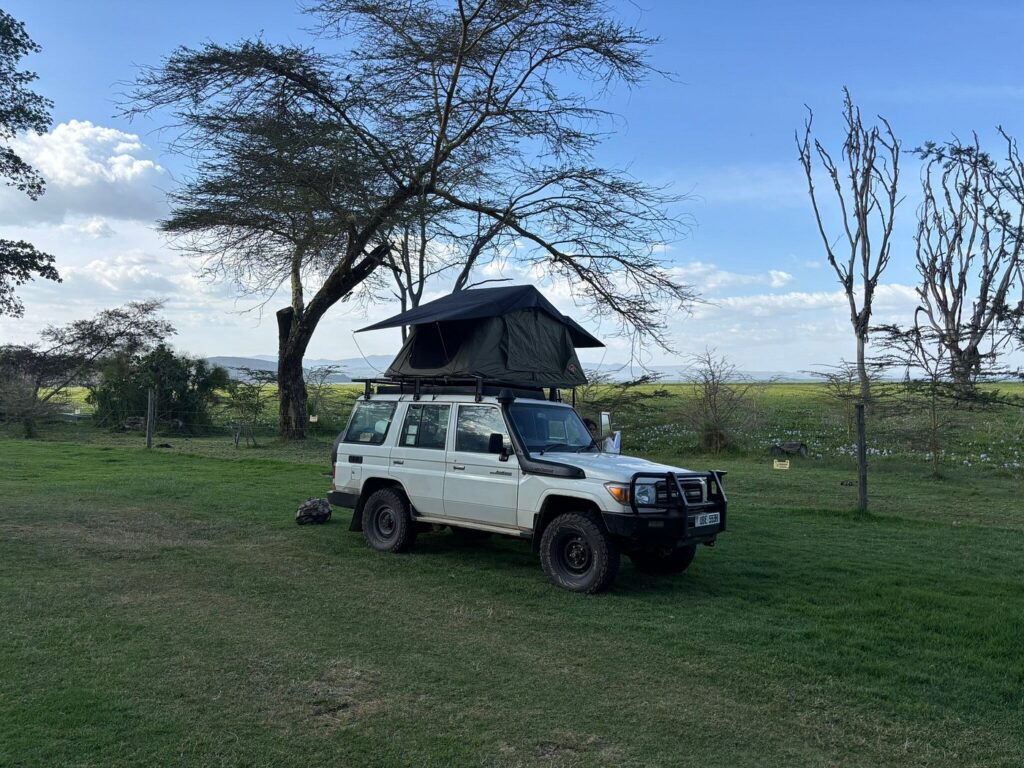
| 4×4 with rooftop tent (Land Cruiser TXL / Hilux) | Multi-park camping road trips | Best for Akagera and longer overland routes |
Automatic transmission vehicles are available but represent a minority of the rental fleet; book well ahead if you’re not comfortable with manual gear changes on steep, winding roads. Whichever vehicle you choose, confirm before departure that it includes a full-size spare tyre, a working jack, a first-aid kit, and a fully charged phone mount or GPS unit, since mobile signal is reliable across most of the country but can lapse briefly in remote park sections.
Road Conditions and Driving Tips by Region
Kigali City
Kigali’s roads are smooth, well signposted, and increasingly monitored by automated speed cameras, with a 40 km/h city limit strictly enforced. Roundabouts are common and right-of-way generally favours traffic already circulating. Parking is straightforward at hotels and malls but limited on some central streets.
Kigali to Musanze (Volcanoes National Park)
This roughly 80-kilometre route is fully paved and typically takes about two hours, winding through terraced hillsides and small trading towns. Watch for unmarked speed bumps at village entrances and for pedestrians and cyclists sharing the road shoulder, particularly around Musanze town itself.
Kigali to Nyungwe National Park
At around 200 kilometres, this is the longest paved drive on a standard itinerary, taking four to five hours through the southern highlands. The road is tarmacked but mountainous and heavily curved; plan for a slower average speed and avoid driving after dark, when visibility on tight bends drops sharply.
Akagera National Park and the Eastern Route
The approach to Akagera is paved to the park gate, but internal game-viewing roads are unsealed murram tracks that become slippery after rain. A 4×4 is effectively mandatory for self-drive game drives inside the park, and the park itself recommends checking road status at the gate before setting out during the wet seasons.
| Driving Safety Essentials
• Drive on the right; keep to signposted speed limits, especially the 40 km/h Kigali city limit. • Avoid night driving outside Kigali — unlit road sections, pedestrians, and livestock are the main hazards after dark. • Keep the fuel tank at least half full; rural fuel stations exist but are less frequent than in Kigali. • Agree on the rental company’s fuel policy (commonly full-to-full) before you leave, to avoid disputes at return. • Lock doors and secure valuables when parked in towns; avoid isolated areas after dark, as with any destination. |
Self-Drive Rwanda: Typical Costs
Costs vary by vehicle class, season, and rental company, but the ranges below give a realistic planning baseline for a 2026 self-drive trip. Prices generally exclude fuel, park entrance fees, and gorilla or chimpanzee trekking permits, which are booked separately through the Rwanda Development Board.
| Item | Approximate Range (USD) | Notes |
| 2WD SUV, per day | $45 – $75 | Best for Kigali and paved corridors only |
| 4×4 SUV, per day | $80 – $140 | Recommended for most self-drive itineraries |
| 4×4 with rooftop tent, per day | $120 – $200 | Includes camping gear for overland routes |
| Comprehensive insurance upgrade, per day | $10 – $25 | Strongly recommended over basic liability cover |
| Security deposit | $500 – $1,500 | Held on credit card, refunded after return inspection |
| Fuel | Pay at pump | Petrol and diesel widely available in Kigali and along main routes |
Gorilla trekking permits and other park fees sit outside the rental cost entirely and should be budgeted separately; permit prices and availability change periodically, so confirm current rates directly with the Rwanda Development Board before finalising your itinerary.
Sample Self-Drive Itineraries
3–4 Days: Volcanoes National Park Express
- Day 1: Depart Kigali early, drive the paved route to Musanze (about 2 hours), settle in near the park.
- Day 2: Pre-dawn briefing at park headquarters, gorilla or golden monkey trekking, afternoon at leisure.
- Day 3: Optional second trek, or a visit to Lake Burera / Lake Ruhondo, then return drive toward Kigali.
- Day 4: Final Kigali city stops (Kigali Genocide Memorial, local markets) before departure.
7–8 Days: Volcanoes, Lake Kivu & Nyungwe Loop
- Days 1–2: Kigali to Musanze; gorilla trekking briefing and trek the following morning.
- Days 3–4: Drive west to Gisenyi/Rubavu on Lake Kivu; relax lakeside, scenic driving along the Congo Nile Trail edge.
- Day 5: Continue south along Lake Kivu toward Nyungwe National Park; forest walks and canopy walkway.
- Day 6: Chimpanzee trekking or birdwatching in Nyungwe; overnight near the park.
- Day 7: Return drive to Kigali via the southern highlands route, arriving late afternoon.
- Day 8: Buffer day for delays, shopping, or an added Kigali city tour.
10–14 Days: Full Rwanda Explorer
- Route: Combine Volcanoes National Park, Lake Kivu, Nyungwe National Park, and Akagera National Park in a single loop.
- Akagera add-on: Add a Big Five game drive circuit inside Akagera using a 4×4, ideally with an early-morning and a late-afternoon game drive.
- Cultural stops: Build in cultural stops such as the Kigali Genocide Memorial and, time permitting, the King’s Palace Museum in Nyanza.
- Buffer: Reserve at least one full unstructured day for weather delays, permit rescheduling, or vehicle issues.
Best Time for a Rwanda Self-Drive Trip
| Season | Months | Driving Conditions |
| Long dry season | June – August | Best road conditions; peak gorilla trekking demand — book early |
| Short dry season | December – February | Good driving conditions, fewer crowds than June–August |
| Long rainy season | March – May | Lush scenery, lower rates, slippery unpaved park roads — 4×4 essential |
| Short rainy season | October – November | Similar trade-offs to March–May; good value season |
Dry-season months offer the most predictable driving conditions and are the easiest introduction to self-drive for first-time visitors, but they also carry the highest demand for gorilla permits and rental vehicles — both should be booked well in advance. The rainy seasons trade some driving difficulty on unpaved park roads for lush landscapes, lower rates, and thinner crowds, and are a reasonable option for confident 4×4 drivers.
Frequently Asked Questions
Q: Can foreigners legally self-drive in Rwanda?
A: Yes. Foreign visitors can drive in Rwanda using a valid driving licence from their home country, generally recognised for tourists for up to 90 days. An International Driving Permit is strongly recommended and required by some rental companies, particularly for licences not issued in a Latin script.
Q: Which side of the road does Rwanda drive on?
A: Rwanda drives on the right-hand side of the road, with the steering wheel on the left side of the vehicle — the same convention used in most of mainland Europe and North America.
Q: Do I need a 4×4 to self-drive in Rwanda?
A: For a Kigali-only or Kigali-to-Musanze trip on paved roads, a 2WD vehicle can suffice. For Akagera’s internal game-viewing roads, the approach to Nyungwe, or any travel during the rainy seasons, a 4×4 is strongly recommended and often required by park regulations.
Q: How far is Kigali from the main national parks?
A: Kigali to Musanze (Volcanoes National Park) is about 80 kilometres, roughly a two-hour drive. Kigali to Nyungwe National Park is around 200 kilometres, taking four to five hours given the mountainous, winding route.
Q: Is self-driving in Rwanda safe?
A: Rwanda is widely regarded as one of Africa’s safest countries for independent road travel, with orderly traffic, consistent policing, and low crime rates. Standard precautions still apply: avoid night driving outside Kigali, watch for pedestrians and cyclists on rural roads, and secure valuables when the vehicle is parked.
Q: What is the minimum age to rent a self-drive car in Rwanda?
A: Rwanda’s legal minimum driving age is 18, but most rental companies set their own minimum of 23 to 25 years old, and many apply a young-driver surcharge for renters under 25.