
List of Self drive Camping Equipment’s in Uganda
List of Self drive Camping Equipment’s in Uganda, Complete Guide to Safari Camping Gear for Your Uganda Self-Drive Adventure
Uganda — the Pearl of Africa — is home to some of East Africa’s most spectacular wilderness areas: from the misty mountain gorilla forests of Bwindi Impenetrable National Park to the sweeping savannah of Queen Elizabeth National Park, the thundering Murchison Falls, and the remote wetlands of Kidepo Valley. Self-drive camping is one of the most immersive, cost-effective, and adventurous ways to experience this extraordinary country.
This comprehensive guide to self-drive camping equipment in Uganda covers every piece of gear you need — from rooftop tents and sleeping systems to cooking kits, 4×4 recovery tools, and national park-specific essentials. Whether you’re renting a fully-equipped Land Cruiser or bringing your own vehicle, understanding the right camping equipment will make your Uganda safari safer, more comfortable, and more rewarding.
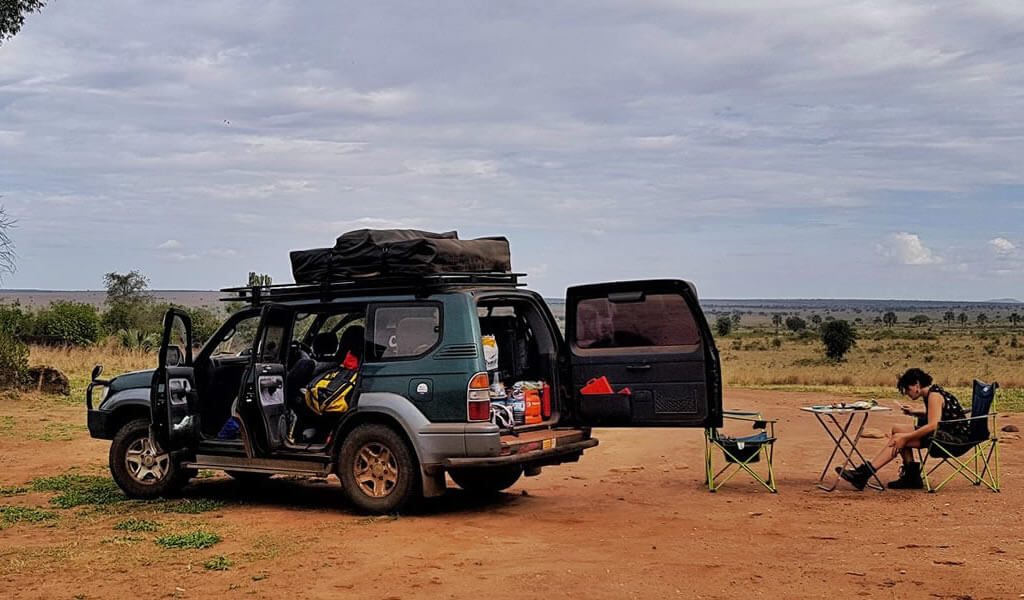
| 1. Why Self-Drive Camping in Uganda? |
The Case for Self-Drive Camping Safari in Uganda
Uganda’s national parks and wildlife reserves offer designated public campsites and community campsites at remarkably affordable rates — often between USD $30–$50 per night — making self-drive camping far cheaper than lodge-based safaris. With the right camping equipment, a self-drive safari gives you the freedom to game drive at dawn and dusk (the best hours for wildlife), sleep inside or close to the park, and control your own schedule.
The four primary destinations for self-drive campers in Uganda are:
- Murchison Falls National Park — Uganda’s largest park, home to lions, elephants, giraffes, and Nile crocodiles
- Queen Elizabeth National Park — Famous for tree-climbing lions, hippos, and prolific birdlife along the Kazinga Channel
- Bwindi Impenetrable National Park — Mountain gorilla trekking; cool, high-altitude terrain requiring warm camping gear
- Kidepo Valley National Park — Uganda’s most remote and wild park; cheetahs, ostriches, and minimal tourist traffic
- Lake Mburo National Park — A compact, accessible park near Kampala; zebras, impalas, and excellent birding
| 💡 Pro Tip: A rooftop tent mounted on a 4WD vehicle is the most popular self-drive camping setup in Uganda. It keeps you elevated above ground-level wildlife (particularly important near hippo corridors), provides a dry sleeping platform in heavy rain, and sets up in minutes after a long day of driving. |
| 2. The Essential Camping Vehicle: Choosing Your 4×4 |
Best Vehicles for Self-Drive Camping in Uganda
Before discussing camping equipment, your vehicle choice defines what gear is possible. Uganda’s roads — particularly inside national parks — are unpaved, rutted, and seasonally waterlogged. A capable 4×4 with high ground clearance is non-negotiable.
| Vehicle | Best For | Camping Capacity |
| Toyota Land Cruiser 70/78 Series | Kidepo, Murchison (heavy terrain) | 2 adults (rooftop tent) |
| Toyota Land Cruiser V8 200 Series | All parks; comfort + capability | 2–3 adults with roof tent |
| Toyota Land Cruiser Prado | Queen Elizabeth, Lake Mburo | 2 adults comfortably |
| Toyota RAV4 (4WD) | Lake Mburo, Mgahinga (dry season) | 2 adults (roof tent) |
| Toyota Hilux Double Cab | All-around overlanding | 2–4 adults (tent in bed) |
| Nissan Patrol | Heavy terrain; Kidepo | 2–3 adults |
Most Uganda self-drive car rental companies supply Land Cruisers pre-fitted with rooftop tents, roof racks, kitchen kits, and sleeping gear as an all-inclusive camping package. Always confirm what equipment is included before departure.
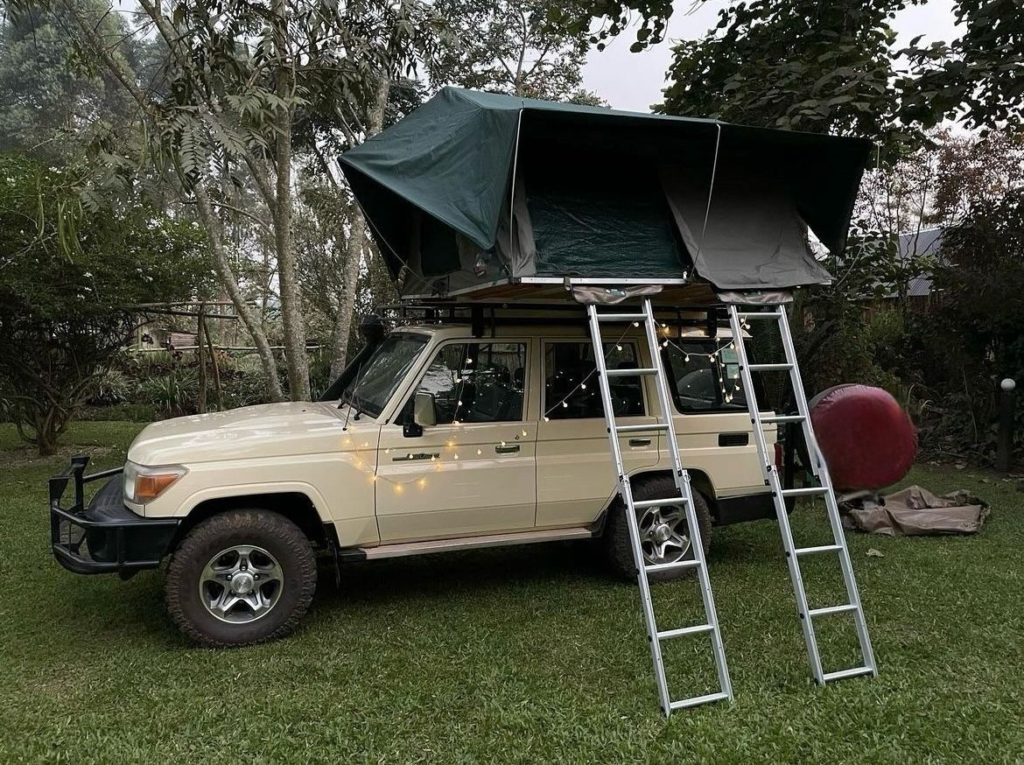
| 3. Shelter & Sleeping Equipment |
Rooftop Tents for Uganda Self-Drive Safaris
A rooftop tent (RTT) is the single most important piece of camping equipment for a Uganda self-drive safari. Mounted on the vehicle’s roof rack, it unfolds into a full sleeping platform elevated 1.5–2 metres above the ground.
Hard-Shell vs. Soft-Shell Rooftop Tents
| Feature | Hard-Shell RTT | Soft-Shell RTT |
| Setup time | 30–60 seconds | 2–4 minutes |
| Wind resistance | Excellent | Good |
| Rain performance | Excellent | Very good |
| Weight | 55–90 kg | 30–55 kg |
| Cost (rental/night) | ~$20–35/night | ~$12–25/night |
| Insulation (Bwindi cold) | Superior | Adequate with liner |
| Popular brands in UG | James Baroud, Alu-Cab | Autohome, CVT |
| 🏕️ Bwindi & High-Altitude Note: Night temperatures at Bwindi Impenetrable NP and Mgahinga Gorilla NP can drop to 8–12°C. Always request a hard-shell tent or ensure your soft-shell tent has a thermal liner. A warm sleeping bag rated to 5°C is essential here. |
Ground Tents for Uganda Camping
Some campsites — particularly in Murchison Falls and Queen Elizabeth NP — permit ground camping, but wildlife awareness is paramount. If camping on the ground:
- Always use a three-season tent with a fully waterproof rain fly and bathtub floor
- Stake it properly — Uganda’s afternoon thunderstorms can be violent
- Never camp directly on hippo paths near rivers or lakes
- Use a vestibule tent to store muddy boots and equipment outside the sleeping area
- Ground camping is NOT recommended at Kidepo Valley NP without permanent staff presence
Sleeping Systems: Bags, Pads & Pillows
| Item | Specification Needed | Notes |
| Sleeping bag | Comfort rating 5–10°C | Upgrade to 0°C for Bwindi/Mgahinga |
| Sleeping mat / pad | Self-inflating, R-value 3+ | Most RTTs include foam mattress |
| Foam mattress (RTT) | 5–8 cm high-density foam | Usually supplied by rental company |
| Pillow | Compressible camping pillow | Pack your own for hygiene |
| Sleeping bag liner | Silk or cotton | Adds 5°C warmth; essential at altitude |
| 4. Cooking & Kitchen Equipment |
Camp Kitchen Equipment for Uganda Safari
Self-catering is the primary cost-saving strategy on Uganda self-drive safaris. Fuel stoves, portable refrigerators, and a well-stocked camp kitchen box can cut your daily food budget to USD $15–25 per person versus $60–100 at lodge restaurants.
Cooking Stoves & Fuel
- Two-burner gas stove — Most popular setup; runs on LPG canisters available in Kampala, Masindi, Kasese, and Fort Portal
- Three-burner camp stove — Ideal for groups of 4+; allows simultaneous cooking
- Dometic/Coleman dual-fuel stove — More versatile; uses petrol as backup when LPG unavailable in remote areas
- Trangia alcohol stove — Lightweight backup stove; useful in Kidepo where LPG supply is unreliable
- Firewood cooking — Permitted at some campsites; check park regulations; never cut live trees
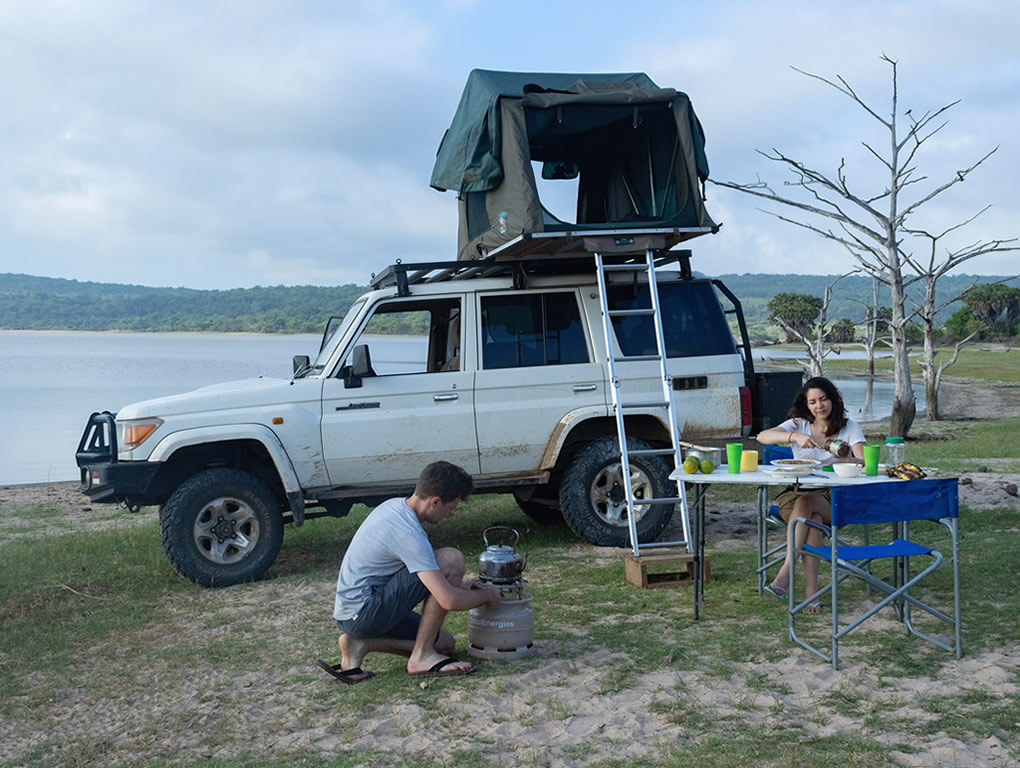
| ⛽ Fuel Availability: LPG camping gas canisters are readily available in Kampala (Garden City Mall, Nakumatt), Masindi (for Murchison Falls), Kasese (for Queen Elizabeth NP), and Kabale (for Bwindi). In Kidepo Valley, supply is unreliable — carry a dual-fuel backup stove and extra fuel. |
Camp Kitchen Box: Full Equipment List
| Equipment | Quantity (2 pax) | Notes |
| Cooking pot set (1L, 2L, 4L) | 1 nested set | Stainless steel preferred |
| Frying pan (28–30cm) | 1 | Non-stick; handles game meat well |
| Kettle | 1 (1.5L) | For tea, coffee, hot water |
| Plates (melamine) | 2–4 | Durable, lightweight |
| Bowls (melamine) | 2–4 | Dual-purpose for soup/cereal |
| Mugs | 2–4 | Insulated mugs for cold mornings |
| Cutlery set (fork, knife, spoon) | 2–4 sets | Stainless steel |
| Chopping board | 1 (plastic) | Folding boards save space |
| Sharp cook’s knife | 1 | Essential; pack a knife guard |
| Can opener / bottle opener | 1 | Multi-tool style |
| Serving spoon, spatula, tongs | 1 set | Silicone for non-stick pans |
| Washing basin (collapsible) | 1–2 | For dishwashing at camp |
| Dish soap & sponge | 1 set | Biodegradable soap only in parks |
| Paper towels / dish cloths | 4 rolls / 4 cloths | Both useful |
| Zip-lock bags (various sizes) | Assortment | Food storage, leftovers |
| Aluminum foil | 1 roll | Campfire cooking, food wrapping |
| Fire starter / lighter | 2 (backup) | Windproof lighter recommended |
Portable Refrigerators & Cooler Boxes
Keeping food and drinks cold in Uganda’s equatorial heat (25–35°C in savannah parks) requires either a quality 12V compressor fridge or a high-performance cooler box.
| Option | Performance | Notes |
| Dometic CFX3 35L (12V) | Excellent; cools to -18°C | Best choice; runs off vehicle battery |
| Engel 40L Compressor Fridge | Excellent | Very low power draw; quiet |
| ARB 50L Fridge/Freezer | Excellent; 50L capacity | Ideal for 7+ day safaris |
| Coleman 60Qt Cooler (ice box) | Good for 2–3 days | Budget option; needs daily ice |
| Dometic Waeco 45L | Very good | Popular with Uganda rental fleets |
For a 12V fridge to work safely without draining the vehicle battery at camp, pair it with a dual battery system or a 100W solar panel with a 20A charge controller — both widely available as add-ons from Uganda rental companies.
| 5. Water, Power & Lighting |
Water Systems for Self-Drive Camping in Uganda
Clean water management is critical in Uganda’s national parks. Tap water at public campsites is often from borehole sources and should be treated before drinking. River water is not safe without purification.
| Equipment | Purpose | Recommendation |
| Jerry can (20L) | Water storage & transport | Carry 2–3 (40–60L capacity) |
| Water filter (Sawyer Squeeze / LifeStraw) | Field purification | Essential for remote parks |
| Water purification tablets | Chemical backup | Aquatabs; 1 tablet per 1L |
| UV purifier (SteriPen) | Fast electronic purification | Ideal for camp use |
| Collapsible water container (10L) | Camp sink / washing | Platypus or Sea to Summit |
| Water pump (12V electric) | From jerry can to tap | Useful luxury for long trips |
| 💧 Water Availability by Park: Murchison Falls NP: borehole water at Pakuba & Paraa campsites. Queen Elizabeth NP: piped water at Mweya campsites. Bwindi: clean spring water near most campsites. Kidepo Valley NP: water scarce — carry full 60L capacity from Kidepo airstrip or Moroto town. |
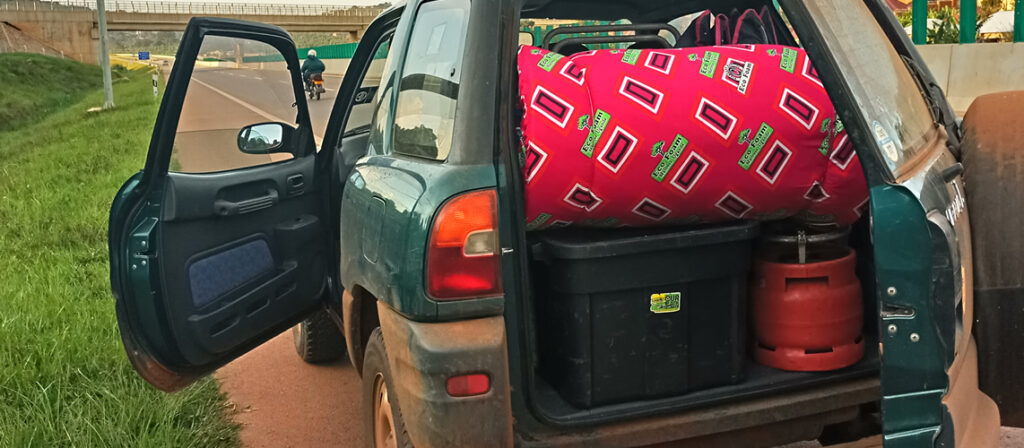
Power & Solar Equipment
- 100W–200W flexible solar panel — Mounts on roof rack; charges leisure battery while driving or parked
- 20A MPPT solar charge controller — Regulates charge to leisure battery; prevents overcharge
- 100Ah AGM or lithium leisure battery — Powers fridge, lighting, and device charging at camp
- 300W power inverter — Converts 12V DC to 240V AC for laptops and camera battery chargers
- USB charging hub (12V socket) — Multi-port USB hub for phones, GPS, and camera batteries
- Portable power station (Goal Zero Yeti 500X) — Standalone solution; charges via solar or car
Camp Lighting Equipment
- LED camp lantern — Hanging lantern for mess tent or awning area; 300–500 lumens
- Headlamp (x2 per person) — Essential for night walks, tent use, and toilet trips at 3am
- 12V LED strip lights — Waterproof strips mounted under roof rack awning; run off vehicle battery
- Solar-powered garden lights — Stake into ground around campsite; free charging during day
- Candles / camping candle lantern — Romantic backup lighting; useful in remote areas
| 6. Vehicle Equipment & Recovery Gear |
4×4 Recovery & Vehicle Equipment for Uganda Tracks
Uganda’s national park tracks become deeply rutted and waterlogged during the rainy seasons (March–May and October–November). Even experienced 4×4 drivers get stuck. The right recovery equipment — and knowing how to use it — is essential.
| Recovery Item | Priority | Use Case |
| Hi-Lift jack (48 inch) | Essential | Vehicle recovery from mud; tire changes |
| Sand/mud recovery boards (MaxTrax) | Essential | Traction in deep mud or sand |
| Kinetic recovery rope (9m, 9T) | Essential | Snatch recovery between two vehicles |
| D-shackles (4.75T rated) | Essential | Connect tow/recovery points |
| Tow strap (5m) | High | General towing; lighter recovery |
| Manual high-pressure air pump | Essential | Reinflate tyres after airing down |
| Tyre pressure gauge | Essential | Air down for soft terrain |
| Shovel (folding) | Essential | Dig out stuck vehicle |
| Winch (9500 lb rated) | High | Built-in to vehicle for serious recovery |
| Gloves (recovery gloves) | Essential | Hand protection during recovery |
| Snatch block (20T) | Moderate | Double-line winch; tree saver strap |
| Spare tyre (full-size) | Essential | 1 spare minimum; 2 for Kidepo |
| Tyre repair kit (plugs, CO2) | Essential | Field repair of punctures |
| Jumper cables / jump starter | Essential | Battery issues from accessories |
| ⚠️ Rainy Season Alert: The tracks inside Murchison Falls NP (particularly to the northern bank and Chobe area) and the road to Kidepo Valley NP can be extremely challenging from October–November. During these months, confirm track conditions with the Uganda Wildlife Authority (UWA) before departure. Always carry maximum recovery gear. |
Navigation & Communication Equipment
- GPS device (Garmin GPSMAP 66i or similar) — Uganda national park tracks are not on Google Maps; offline maps essential
- me or OsmAnd app — Download Uganda maps offline; free and reliable
- UWA park maps (paper) — Available at each park gate; request at entry
- Two-way radios (walkie-talkies) — Useful when traveling in convoy; 5W range sufficient
- Satellite communicator (Garmin inReach Mini) — Emergency communication from Kidepo or remote areas with no cell coverage
- Mobile data (Airtel/MTN Uganda SIM) — Cell coverage in most park headquarters; absent in Kidepo interior
| 7. Furniture, Comfort & Campsite Setup |
Camp Furniture & Campsite Comfort Equipment
| Item | Quantity (2 pax) | Notes |
| Camp chairs (folding) | 2–4 | Helinox-style or classic camp chair |
| Camp table (folding) | 1 | Aluminum roll-top table; lightweight |
| Awning (270° or 180°) | 1 | Vehicle-mounted; essential shade/rain cover |
| Awning poles & guylines | 1 set | Extends awning coverage |
| Ground tarpaulin (4x6m) | 1 | Under awning; keeps mud out of camp |
| Rope / paracord (30m) | 1 | Clothesline, guy rope repairs |
| Clothes pegs (12+) | Pack | Drying towels and clothes |
| Outdoor doormat | 1 | At tent/vehicle entrance |
| Collapsible wash basin | 1 | Handwashing at camp |
| 8. Safety, Health & Personal Equipment |
Safety & Health Equipment for Uganda Camping
Uganda is a malaria-endemic country. Camping in or near national parks — especially in low-lying savannah areas like Murchison Falls and Queen Elizabeth — means you will be exposed to malaria-carrying mosquitoes at dusk and dawn. Prevention is non-negotiable.
Medical & First Aid Kit
- Antimalarial medication (Malarone / Doxycycline) — Consult your doctor before travel; start prophylaxis on schedule
- Comprehensive first aid kit — Plasters, bandages, antiseptic wipes, wound closures, trauma dressings
- Insect repellent (DEET 30–50%) — Apply every evening; reapply after sweating or swimming
- Mosquito net (free-standing) — For sleeping in open-sided bandas or when tent mesh is insufficient
- Permethrin-treated clothing — Pre-treat long sleeves and trousers for extra protection
- Oral rehydration salts — Essential in hot savannah parks where dehydration risk is high
- Broad-spectrum antibiotics (prescribed) — For remote areas; ciprofloxacin or azithromycin
- Antihistamines — For insect bites, allergic reactions, and plant-contact rashes in Bwindi
- Eye wash solution — Dust on dry-season tracks can be severe
- Blister plasters — Hours of game drive vibration leads to foot hotspots on walking days
| 🦟 Malaria Prevention in Uganda: Malaria is present year-round in Uganda’s lowland parks. Symptoms appear 7–30 days after infection. If you develop fever, chills, or flu-like symptoms within 30 days of returning, seek immediate medical attention and tell the doctor you’ve been in a malaria-endemic area. |
Fire Safety & Wildlife Safety Equipment
- Fire extinguisher (1kg dry powder, vehicle-mounted) — Mandatory in Uganda; vehicle fire risk from grass fire contact
- Fireproof gloves — Handling hot cookware; campfire management
- Torch/flashlight (high-lumen, 500lm+) — For scanning campsite perimeter at night
- Air horn / bear banger — Deterrent for close-range elephant or buffalo encounters at camp
- Wildlife book / identification guide — Field guides to Uganda mammals and birds add enormously to the experience
| 9. Hygiene & Sanitation Equipment |
Camp Hygiene & Sanitation Equipment
- Portable camp shower (solar) — Black 10L solar shower bag heats in 2–3 hours of sun; hang from roof rack
- Portable camp toilet — Essential for remote camping away from park facilities; WAG bags for waste
- Biodegradable camp soap & shampoo — Mandatory in national parks; standard soaps pollute waterways
- Hand sanitizer (large bottle) — Use before every meal; critical in areas without running water
- Microfibre towels (x2 per person) — Dry in 30 minutes; pack lightweight
- Toilet paper & wet wipes — Always carry extras; distribution in remote Uganda is unreliable
- Rubbish bags (heavy-duty, 20+) — Carry out all waste from national parks; zero-trace policy
- Trowel — Cat-hole digging for human waste when no toilet is available
| 10. Photography & Safari Observation Gear |
Photography & Wildlife Observation Equipment
- Binoculars (8×42 or 10×42) — Essential for birding and distance wildlife observation
- Camera with telephoto lens (300mm+) — For wildlife photography; image stabilization essential in game drives
- Bean bag (window mount) — Rests on vehicle window frame for stable telephoto shots
- Lens cleaning kit — Dust on Uganda’s tracks gets into everything
- Extra memory cards & batteries — Charge daily at camp via solar/power bank
- Laptop / external SSD — For backing up photos daily on long safaris
- Pop-up vehicle roof hatch — Available as upgrade on some Land Cruisers; ideal 360° game viewing platform
| 11. Uganda National Park Camping Fees 2024/2025 |
Uganda Wildlife Authority (UWA) Camping Fees
The following are UWA-approved public campsite fees per person per night (non-resident rates):
| National Park | Camping Fee (USD/person/night) | Notes |
| Murchison Falls NP | $30 / person | Public campsites at Paraa, Buligi, Nile Safari |
| Queen Elizabeth NP | $30 / person | Mweya, Ishasha, Kyambura campsites |
| Bwindi Impenetrable NP | $35 / person | Multiple sector campsites; book via UWA |
| Kidepo Valley NP | $30 / person | Apoka public campsite; reserve ahead |
| Lake Mburo NP | $25 / person | Multiple lakeside campsites |
| Mgahinga Gorilla NP | $30 / person | Community campsites near park |
| Kibale National Park | $30 / person | Kanyanchu & Bigodi campsites |
| 📋 UWA Booking: Public campsite fees are paid at the park gate. Community campsites outside the parks may be booked directly with local operators. For high-demand parks like Bwindi, pre-booking via UWA headquarters in Kampala is strongly recommended, especially during peak season (June–September, December–February). |
| 12. Where to Rent Camping Equipment in Uganda |
Hiring Self-Drive Camping Equipment in Uganda
Most travelers hire camping equipment as part of a fully-equipped vehicle package. The following equipment types are available for rental across Uganda’s main self-drive operators:
| Equipment | Daily Rental Cost (Approx.) | Availability |
| Rooftop tent (soft-shell) | $15–25/night | Kampala, Entebbe, Jinja |
| Rooftop tent (hard-shell) | $25–40/night | Kampala, Entebbe |
| Ground tent (2-person) | $8–15/night | Kampala operators |
| Sleeping bag | $5–10/night | Widely available |
| Camp kitchen box (full) | $15–25/day | Usually included with vehicle |
| 12V compressor fridge (45L) | $10–20/day | Major operators |
| Solar panel (100W) + battery | $15–25/day | Major operators |
| Camp table + 4 chairs | $10–15/day | Most operators |
| Vehicle awning (180°) | $15–20/day | Land Cruiser specialists |
| Hi-Lift jack + recovery boards | $10–15/day | Included on most 4x4s |
| GPS device (Garmin) | $5–10/day | Available on request |
We are the Leading Uganda self-drive operators with full camping equipment packages include rental companies based in Kampala (along Entebbe Road and Nakasero), Entebbe town, and Jinja. When booking, always request a full equipment manifest in advance and inspect all items at vehicle handover.
| 13. Packing Checklist: Complete Camping Equipment List |
Uganda Self-Drive Camping Equipment: Master Checklist
| ✓ | SHELTER & SLEEP | ✓ | COOKING & KITCHEN |
| ☐ | Rooftop tent (hard/soft shell) | ☐ | Two-burner gas stove |
| ☐ | Ground tent (backup) | ☐ | LPG gas cylinder (full) |
| ☐ | Sleeping bag (5°C rated) | ☐ | Pots & pans set |
| ☐ | Sleeping mat / foam pad | ☐ | Kettle |
| ☐ | Sleeping bag liner | ☐ | Plates, bowls, mugs, cutlery |
| ☐ | Pillow (compressible) | ☐ | Chopping board & knife |
| ☐ | Tent pegs & guylines | ☐ | 12V compressor fridge |
| ☐ | Tent repair kit | ☐ | Cooler box (backup) |
| ✓ | WATER & POWER | ✓ | VEHICLE & SAFETY |
| ☐ | 20L jerry cans (x3) | ☐ | Hi-Lift jack |
| ☐ | Water filter / SteriPen | ☐ | Sand recovery boards |
| ☐ | Purification tablets | ☐ | Kinetic recovery rope |
| ☐ | 100W solar panel | ☐ | D-shackles & tow strap |
| ☐ | 20A MPPT charge controller | ☐ | Spare tyre (x2 for Kidepo) |
| ☐ | 100Ah leisure battery | ☐ | Tyre repair kit |
| ☐ | LED camp lantern | ☐ | Fire extinguisher |
| ☐ | Headlamps (x2 per person) | ☐ | First aid kit |
| ☐ | USB charging hub | ☐ | GPS device + offline maps |
| 14. Tips for a Successful Uganda Self-Drive Camping Safari |
Top Tips for Self-Drive Camping in Uganda’s National Parks
- Book campsites in advance: Uganda Wildlife Authority campsites — especially in Bwindi, Kidepo, and Murchison — fill up during peak season. Book at least 4–6 weeks ahead for June–September travel.
- Air down your tyres inside parks: Reduce tyre pressure to 1.8–2.0 bar (26–29 PSI) on unpaved tracks for better traction and reduced puncture risk. Re-inflate before returning to tarmac.
- Start game drives at 6:00–6:30 AM: Dawn is when lions return from night hunts, elephants are most active at waterholes, and light is ideal for photography. Campsites inside parks give you this massive advantage over lodge guests driving in from outside.
- Never leave food outside at night: Hippos graze camp areas after dark. Store all food inside the vehicle or in a hard-sided cooler. Never leave cooking smells near the tent.
- Carry more fuel than you think you need: Fuel is unavailable inside parks. Fill up in the nearest town before entry: Masindi (Murchison Falls), Kasese (Queen Elizabeth), Kabale/Buhoma (Bwindi), Moroto (Kidepo). Carry a 20L jerry can of petrol or diesel as backup.
- Always travel with a park map: Collect the UWA park map at the gate. Many internal tracks are not on digital maps and correct navigation is essential.
- Never approach wildlife on foot: Unless on a guided walking safari with an armed ranger. Buffalo, hippo, and elephant are the most dangerous animals at campsites. Respect them.
- Check your equipment at handover: Before leaving the rental depot, test the stove, check the fridge is cooling, verify the rooftop tent opens smoothly, and check tyre pressures including the spare. Problems discovered in Kidepo cannot be solved in Kidepo.