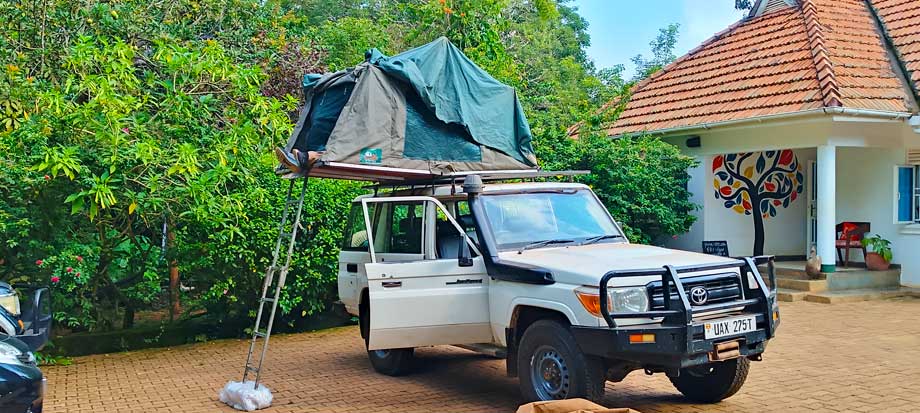
20 Days 4×4 Self Drive Car rental with Rooftop tent and Camping, Uganda & Rwanda
20 Days 4×4 Self Drive Car rental with Rooftop tent and Camping, Uganda & Rwanda , A 20-day 4×4 self-drive rooftop tent safari across Uganda and Rwanda is one of the most rewarding overland adventures on the African continent. Unlike guided tours, self-driving puts you in full control — you set your own pace, linger at a watering hole as long as you wish, and wake up inside national parks surrounded by wildlife, under canvas in the open wilderness.

Uganda alone is home to half the world’s mountain gorillas, over 1,000 bird species, tree-climbing lions, chimpanzees, and the thundering Murchison Falls — the world’s most powerful waterfall. Cross into Rwanda and you add Volcanoes National Park’s gorilla families and Akagera’s resurgent Big Five savanna. Combining both countries in a 20-day rooftop tent overland journey creates an unparalleled multi-ecosystem safari experience.
This comprehensive self-drive safari guide covers everything you need: a day-by-day itinerary, the best 4×4 rental vehicles with rooftop tents, camping fees, park entrance costs, border crossing procedures, driving distances, road conditions, and expert tips for first-time overlanders in East Africa.
| 📊 Safari Quick Statistics |
| 🗓️ Duration: 20 Days / 19 Nights |
| 📍 Countries: Uganda + Rwanda (2-country overland) |
| 🚗 Total Driving Distance: approx. 2,450 km |
| 🏕️ Camping Style: Rooftop Tent on 4×4 Vehicle |
| 🦍 Gorilla Treks: Up to 3 opportunities (Bwindi, Mgahinga, Volcanoes NP) |
| 🌿 Parks & Reserves: 8 national parks + Lake Bunyonyi |
| 🐦 Bird Species Possible: 600+ across all parks |
| 💰 Estimated Budget: USD 3,800 – 6,200 per person (excl. gorilla permits) |
Choosing the Right 4×4 Vehicle with Rooftop Tent
The foundation of a successful self-drive safari is selecting the right 4×4 vehicle. East Africa’s national park tracks range from smooth murram roads to deep river crossings and rocky escarpment trails. Only a genuine 4-wheel drive vehicle with high ground clearance is suitable for full park access — saloon cars and 2WD SUVs are not permitted in most Uganda and Rwanda parks.
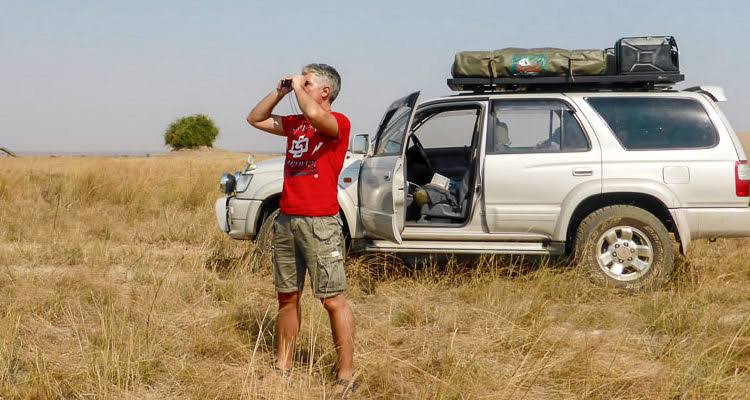
Top 4×4 Vehicles Available for Rental in Uganda & Rwanda
| Vehicle | Best For | Fuel Type | Approx. Daily Rate (USD) |
| Toyota Land Cruiser 70 Series | Heavy off-road, full expedition | Diesel | $130 – $180 |
| Toyota Land Cruiser 100 / 200 Series | Luxury comfort + off-road | Diesel | $150 – $220 |
| Toyota Land Cruiser Prado 150 | Mid-size, fuel efficient | Diesel | $110 – $160 |
| Toyota RAV4 (4WD) | Light tracks, budget option | Petrol/Diesel | $70 – $110 |
| Nissan Patrol Y61 | Heavy duty, high clearance | Diesel | $120 – $170 |
Rooftop Tent Setup: What’s Included
All reputable 4×4 rental operators in Kampala and Entebbe offer vehicles pre-fitted with rooftop tents. A standard rooftop tent rental package should include:
- Hard-shell or soft-shell rooftop tent (2-person capacity standard)
- High-density foam mattress with fitted sheets
- Roof rack and tent mounting hardware
- Access ladder (aluminium fold-out)
- Weather canopy / rain fly
- Interior LED lighting strip
- Camp kitchen kit: gas stove, cookware, plates, cutlery
- Camping chairs and folding table
- Jerry cans (20L fuel + 20L water)
- Tow rope, hi-lift jack, spare tyre (often 2)
- First aid kit and fire extinguisher
| 🔧 Vehicle Rental Tips |
| ✅ Always inspect the vehicle in daylight before signing the rental agreement |
| ✅ Confirm the rooftop tent opens/closes smoothly and latches securely |
| ✅ Test 4WD engagement (Low and High range) before departing Kampala |
| ✅ Ensure GPS or offline maps (Maps.me / OsmAnd) are loaded with Uganda & Rwanda data |
| ✅ Request a full spare tyre — not a space-saver for remote park driving |
| ⚠️ Border crossing permission must be explicitly stated in your rental agreement |
| ⚠️ Carry both your rental contract and vehicle registration across the border |
20-Day Day-by-Day Itinerary: Uganda to Rwanda Overland
This 20-day self-drive itinerary is designed as a grand circuit departing and returning to Entebbe/Kampala, crossing into Rwanda at the Cyanika or Katuna border. The route is structured to minimize backtracking while maximizing wildlife diversity, cultural encounters, and scenic variety.
| Day | Location / Route | Drive (km) | Campsite | Highlight |
| 1 | Kampala / Entebbe → Murchison Falls | 310 | Red Chilli Rest Camp (public site) | Delta sunset, hippos at dusk |
| 2 | Murchison Falls – Game Drive & Falls | 60 | Red Chilli Rest Camp | Nile Delta boat cruise, Murchison Falls hike |
| 3 | Murchison Falls – North Bank Drive | 80 | Red Chilli Rest Camp | Lions, elephants, Rothschild’s giraffes |
| 4 | Murchison Falls → Kibale Forest | 300 | Kibale Forest Camp | Chimp tracking permits |
| 5 | Kibale Forest – Chimpanzee Trekking | 20 | Kibale Forest Camp | Primate canopy walk, Bigodi Wetlands |
| 6 | Kibale → Queen Elizabeth NP | 100 | Mweya Camp (public) | Flamingo Lake vista, arrival game drive |
| 7 | Queen Elizabeth – Kazinga Channel Cruise | 50 | Mweya Camp | Buffalo, hippos, shoebill storks |
| 8 | Queen Elizabeth – Ishasha Sector | 130 | Ishasha Wilderness Camp | Tree-climbing lions of Ishasha |
| 9 | Ishasha → Bwindi Impenetrable Forest | 80 | Buhoma Community Camp | Mountain gorilla trekking briefing |
| 10 | Bwindi – Gorilla Trekking Day | 10 | Buhoma Community Camp | Mountain gorilla habituation experience |
| 11 | Bwindi → Lake Bunyonyi | 90 | Lake Bunyonyi Eco Resort Campsite | Canoe, island hopping, 29 islands |
| 12 | Lake Bunyonyi → Mgahinga Gorilla NP | 60 | Mgahinga Community Campsite | Batwa cultural trail, volcano trekking |
| 13 | Mgahinga – Volcano Hike & Golden Monkey Trek | 15 | Mgahinga Community Campsite | Mt. Sabyinyo crater rim sunrise |
| 14 | Mgahinga → Kigali (Rwanda) | 170 | Kigali Camping & Hostel | Kigali Genocide Memorial, city tour |
| 15 | Kigali → Volcanoes NP (Rwanda) | 110 | Kinigi Community Camp | Dian Fossey Tomb hike, Karisimbi |
| 16 | Volcanoes NP – Golden Monkey / Gorilla Trek | 20 | Kinigi Community Camp | Second gorilla family trek opportunity |
| 17 | Volcanoes NP → Akagera NP | 260 | Akagera Camping Site | Big Five savanna park, lions, rhinos |
| 18 | Akagera – Full Day Game Drive | 120 | Akagera Camping Site | Boat safari on Lake Ihema |
| 19 | Akagera → Kigali → Entebbe (Uganda) | 380 | Entebbe / Lakeside Campsite | Uganda Wildlife Education Centre |
| 20 | Entebbe – Departure Day | — | Flight departure | Botanical gardens, Entebbe Beach farewell |
Detailed Day-by-Day Safari Narratives
Days 1–3: Murchison Falls National Park
Begin your 20-day East Africa overland adventure from Kampala or Entebbe airport. After a pre-arranged vehicle pickup and rooftop tent inspection, head north on the Kampala–Gulu highway towards Uganda’s largest national park. The 310 km drive takes approximately 5–6 hours and passes through the Ziwa Rhino Sanctuary — Africa’s only wild white rhino breeding program outside South Africa — where a brief stop to track rhinos on foot is highly recommended.
Murchison Falls National Park straddles the Victoria Nile as it explodes through a 7-metre gorge with tremendous force — the world’s most powerful waterfall by volume. Three nights allows you to experience the park fully: the northern bank circuit where lions, giraffes, and elephants roam open savanna; the Victoria Nile boat cruise to the base of the falls where hippos and Nile crocodiles mass; and the Delta sector at Lake Albert where the Nile fans out into papyrus-lined channels rich with shoebill storks and African fish eagles.

Days 4–5: Kibale Forest National Park
Drive south to Kibale Forest, Uganda’s premier destination for chimpanzee trekking. The 300 km journey passes through Fort Portal town, one of Uganda’s most charming highland towns flanked by the Rwenzori Mountains. Kibale Forest National Park protects the highest density of primates in Africa — 13 species including chimpanzees, L’Hoest’s monkeys, olive baboons, and the rare grey-cheeked mangabey. A habituated chimpanzee community trek is the flagship activity, while the Bigodi Wetland Sanctuary community walk provides exceptional birding and colobus monkey sightings.
Days 6–8: Queen Elizabeth National Park
Uganda’s most popular national park offers remarkable ecosystem diversity: open savanna, crater lakes, tropical forest, and the Kazinga Channel — a 32 km natural channel linking Lakes George and Edward. The Mweya Peninsula camp is set dramatically on a cliff above the Kazinga Channel. On Day 8, drive south through the Ishasha sector, famous for the rarest wildlife behaviour in Africa: lions that habitually climb fig trees to escape insects and survey their territory. This sector along the Democratic Republic of Congo border sees far fewer visitors and retains a wild, remote character.
Days 9–10: Bwindi Impenetrable Forest
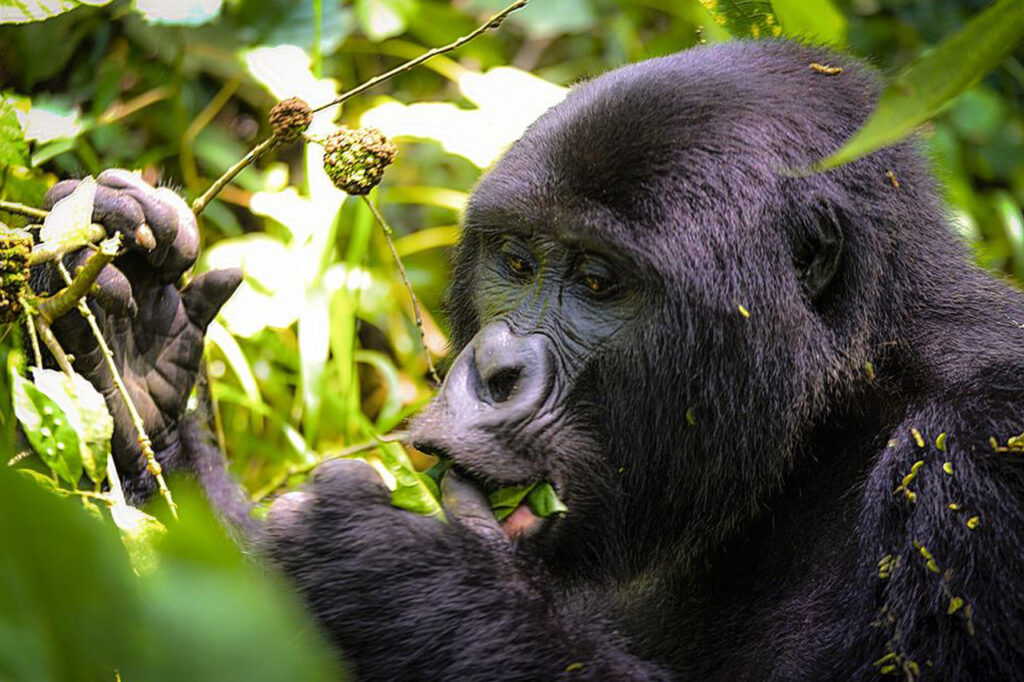
Bwindi Impenetrable National Park, a UNESCO World Heritage Site, protects approximately 459 mountain gorillas — roughly half the global population. The park is divided into four gorilla trekking sectors: Buhoma (north), Ruhija (east), Rushaga (south), and Nkuringo (southwest). The Buhoma sector is the closest to the Ishasha approach and provides access to multiple habituated gorilla families. Gorilla trekking in Bwindi involves hiking through dense tropical forest terrain for anywhere from 30 minutes to 6 hours depending on the day’s gorilla movement — upon finding the family, you receive a precious, regulation-capped 1-hour viewing window at close range.
Days 11–13: Lake Bunyonyi & Mgahinga Gorilla NP
Lake Bunyonyi — ‘place of many little birds’ — is one of Africa’s deepest lakes, cradled among steep terraced hills in southwestern Uganda. Its calm waters, 29 islands, and cool climate make it a perfect mid-safari recovery destination. Canoe paddling around the islands and visiting the Punishment Island and Bwama Island leprosarium ruins offers fascinating cultural context. From Bunyonyi, Mgahinga Gorilla National Park is a 60 km drive into Uganda’s southernmost corner. Mgahinga protects the Virunga volcanic chain within Uganda’s borders — the same chain that shelters gorilla families in Rwanda and DRC. Golden monkey trekking, the Batwa pygmy cultural trail, and volcano hiking (Mt. Muhabura 4,127m, Mt. Gahinga 3,474m, Mt. Sabyinyo 3,645m) fill two rewarding days.
Days 14: Kigali, Rwanda – Border Crossing
Cross into Rwanda at the Cyanika border post near Kisoro. Border procedures are straightforward for East African Community nationals; visitors from other countries typically obtain a Rwanda tourist visa on arrival or pre-apply online. The 170 km drive to Kigali passes through extraordinary terraced highland scenery. Kigali is one of Africa’s cleanest, safest, and most modern capitals — the Kigali Genocide Memorial offers essential context for understanding Rwanda’s modern history and remarkable recovery narrative.
Days 15–16: Volcanoes National Park, Rwanda
Rwanda’s Volcanoes National Park is arguably the world’s most celebrated gorilla trekking destination — the park where Dian Fossey carried out her legendary research and where ‘Gorillas in the Mist’ was filmed. Twelve habituated gorilla families are available for trekking, managed with strict daily permit quotas to minimize habituation impact. Rwanda’s premium gorilla permits (USD 1,500 per person in 2024) reflect the unmatched quality of the experience. Day 15 can also include the Dian Fossey hike to Karisoke Research Centre and her tomb in the forest, while Day 16 offers another trekking opportunity or the golden monkey trek in the bamboo zone.
Days 17–18: Akagera National Park
Complete Rwanda’s Big Five safari experience at Akagera National Park — a conservation success story where lions and black rhinos were successfully reintroduced after being locally extinct for decades. The 260 km drive from Musanze to Akagera traverses Rwanda’s rolling eastern plains. Akagera’s landscape contrasts sharply with the Virungas: open savanna, papyrus swamps, and a chain of shallow lakes form a classic East African ecosystem. Lake Ihema boat safaris deliver spectacular concentrations of hippos (over 1,000 recorded), Nile crocodiles, and waterbirds. Lions, elephants, leopards, buffaloes, and zebras are all well-established in the park’s recovering ecosystem.
Days 19–20: Return to Uganda & Departure
The final stretch of the 20-day overland journey returns through the Kagitumba–Mirama Hills border crossing into Uganda, then south to Kampala and Entebbe. Entebbe’s lakeside setting on Lake Victoria offers a graceful conclusion — the Uganda Wildlife Education Centre houses rescued chimpanzees and other wildlife, and the Entebbe Botanical Garden (site of original Tarzan film shoots) provides a peaceful tropical stroll. Return the vehicle to the rental depot, settle any outstanding fuel costs, and transfer to Entebbe International Airport for your departure flight.
National Park Entrance Fees & Camping Costs (2026–2027)
All park fees are payable at park gates. Uganda Wildlife Authority (UWA) fees apply per person per 24-hour period. Rwanda Development Board (RDB) fees apply per person per day. Some parks offer multi-day packages.
Uganda National Park Fees (per person)
| Park / Activity | Foreign Non-Resident (USD) | East African Resident (USD) | Camping Fee (USD) |
| Murchison Falls NP – Entry | $40/day | $20/day | $30/site (public) |
| Kibale Forest NP – Entry | $40/day | $20/day | $25/site |
| Kibale – Chimp Trekking | $200/person | $150/person | — |
| Queen Elizabeth NP – Entry | $40/day | $20/day | $30/site (Mweya) |
| Bwindi Impenetrable NP – Entry | $40/day | $20/day | $25–$40/site |
| Bwindi – Gorilla Permit | $800/person | $700/person | — |
| Mgahinga Gorilla NP – Entry | $40/day | $20/day | $20/site |
| Mgahinga – Golden Monkey Trek | $100/person | $80/person | — |
| Mgahinga – Gorilla Permit | $800/person | $700/person | — |
| Ziwa Rhino Sanctuary – Rhino Trek | $30/person | $20/person | — |
Rwanda National Park Fees (per person)
| Park / Activity | Fee (USD) | Notes |
| Volcanoes NP – Gorilla Permit | $1,500/person | Per trek, max 1 hour with gorillas |
| Volcanoes NP – Golden Monkey Trek | $100/person | Full day with monkeys |
| Volcanoes NP – Dian Fossey Hike | $75/person | Guided hike to Karisoke |
| Akagera NP – Entry (non-resident) | $40/day | Per person per day |
| Akagera NP – Boat Safari | $35/person | 2-hour Lake Ihema cruise |
| Akagera – Camping | $30/person/night | Akagera campsite |
| Kigali Genocide Memorial | Free (donations welcome) | Highly recommended visit |
Estimated Budget Breakdown for 2 People – 20 Days
| Expense Category | Low Budget (USD) | Mid Budget (USD) | High Budget (USD) |
| 4×4 Vehicle Rental (20 days) | 1,400 | 2,600 | 4,400 |
| Rooftop Tent & Camping Kit (if not bundled) | 200 | 400 | 600 |
| Fuel (≈2,450 km @ avg. 10L/100km) | 600 | 700 | 800 |
| Uganda Park Entry Fees (4 parks × 3 nights) | 480 | 480 | 480 |
| Rwanda Park Entry Fees (2 parks × 2 nights) | 240 | 240 | 240 |
| 2× Uganda Gorilla Permits (Bwindi) | 1,600 | 1,600 | 1,600 |
| 2× Rwanda Gorilla Permits (Volcanoes) | 3,000 | 3,000 | 3,000 |
| Chimpanzee Trekking × 2 persons | 400 | 400 | 400 |
| Golden Monkey Treks (Mgahinga + Rwanda) | 400 | 400 | 400 |
| Camping Fees (19 nights) | 380 | 580 | 800 |
| Food & Groceries (self-catering) | 400 | 600 | 900 |
| Border Fees, Visas & Misc. | 200 | 200 | 300 |
| TOTAL (per 2 persons) | ~$9,300 | ~$11,200 | ~$13,920 |
| PER PERSON ESTIMATE | ~$4,650 | ~$5,600 | ~$6,960 |
| 💡 Budget Saving Tips |
| 🟢 Book gorilla permits 3–6 months in advance — they sell out rapidly for peak season (Jun–Sep, Dec–Feb) |
| 🟢 Self-cater all meals using Kampala supermarkets for major restocking (Nakumatt/Carrefour in Kigali) |
| 🟢 Use public campsites (UWA-managed) rather than lodge campsites for 50–70% savings |
| 🟢 Share a vehicle between 2–4 travellers to split rental costs significantly |
| 🟢 Rwanda gorilla permits are non-negotiable — budget for them as a fixed cost |
| 🟢 Carry enough Ugandan shillings (UGX) and Rwandan francs (RWF) — cards not always accepted at parks |
Road Conditions & Driving Tips for Self-Drive Overlanders
Uganda Road Conditions by Route
| Route Segment | Road Type | Condition | 4WD Required? |
| Kampala → Murchison Falls (via Gulu HW) | Tarmac | Good–Fair | No (but 4WD recommended) |
| Murchison Falls – Park Tracks | Murram/dirt | Rough–Very Rough | Yes (Low Range often needed) |
| Fort Portal → Kibale Forest | Tarmac | Good | No |
| Kibale → Queen Elizabeth NP | Tarmac + Murram | Good–Fair | Yes |
| Queen Elizabeth Park Tracks | Murram/dirt | Rough | Yes |
| Ishasha → Bwindi (Kanungu Road) | Tarmac + Dirt | Fair–Poor (rains) | Yes |
| Bwindi – Forest Tracks | Dirt/Stone | Very Rough | Yes (Low Range) |
| Kisoro → Rwanda Border (Cyanika) | Tarmac | Good | No |
Key Driving Rules & Safety
- Drive on the LEFT side of the road in both Uganda and Rwanda
- Speed limits: 80 km/h on highways, 50 km/h in towns, 40 km/h in parks
- Never drive inside national parks after 7:00 PM — curfew strictly enforced
- Fuel up at every major town — some park routes have 200+ km between stations
- Carry a physical road atlas alongside GPS — satellite signals drop in forest valleys
- Mountain roads in southwestern Uganda and Rwanda require cautious downhill braking
- Rainy seasons (Mar–May, Oct–Nov) make dirt tracks significantly more challenging
- Always engage 4WD before entering muddy, sandy, or rocky park tracks
- Wildlife right of way: stop engines near wildlife, maintain 20m minimum distance on foot
Rooftop Tent Camping Packing List
Packing smart for a 20-day overland rooftop tent safari means balancing weight limits with comfort and safety essentials. Everything fits either into the vehicle interior or a roof-mounted storage box.
Clothing & Personal Gear
- Neutral-coloured safari clothes (khaki, olive, grey — avoid bright colours in parks)
- Waterproof jacket / light rain poncho — essential for gorilla trekking
- Long-sleeved shirts for morning game drives and mosquito protection
- Warm fleece or down jacket — highland nights at Bwindi and Mgahinga drop to 10°C
- Sturdy waterproof hiking boots — mandatory for gorilla and chimpanzee treks
- Sandals or camp shoes for relaxing at campsites
- Wide-brim hat and UV-protection sunglasses for savanna days
- Gaiters (optional but excellent for wet forest trekking)
Health & Medical Kit
- Antimalarial medication (consult your doctor 6–8 weeks before travel)
- DEET insect repellent (50% concentration minimum)
- Yellow fever vaccination certificate (mandatory for Uganda entry)
- Oral rehydration sachets and diarrhoea treatment
- Wound disinfectant, bandages, and blister plasters (essential for trekking days)
- Hand sanitiser and biodegradable soap (use minimal amounts near park water sources)
- Altitude sickness medication if planning Sabyinyo or Muhabura volcano summits
Photography & Technology
- DSLR or mirrorless camera with 100–400mm telephoto lens for wildlife
- Wide-angle lens for landscape and forest interior shots
- Extra batteries and dual-battery charger (power outlets unreliable at remote camps)
- Portable solar charger panel for phone and small devices (attaches to rooftop)
- Dust-proof camera bag — park tracks generate significant dust
- Binoculars (8×42 or 10×42) for birdwatching and distant wildlife spotting
- Offline map apps pre-downloaded: Maps.me, Osm And with Uganda + Rwanda maps
Best Time to Visit: Seasonal Guide
| Season | Months | Conditions | Recommendation |
| Peak Dry Season | Jun – Sep | Sunny, roads excellent, wildlife concentrated at water | ⭐⭐⭐⭐⭐ Best overall |
| Short Dry Season | Dec – Feb | Good weather, gorilla trekking excellent, some crowds | ⭐⭐⭐⭐ Highly recommended |
| Long Rains | Mar – May | Heavy rain, muddy tracks, lush scenery, fewer tourists | ⭐⭐⭐ For experienced overlanders |
| Short Rains | Oct – Nov | Moderate rain, good birding, lower prices | ⭐⭐⭐ Good value season |
For gorilla trekking specifically, the dry seasons (June–September and December–February) offer the most manageable forest trail conditions and clearer views of gorilla families in the forest understory. However, gorillas can be tracked year-round — rainy season treks through misty Bwindi or Volcanoes forest carry their own atmospheric magic.
Uganda–Rwanda Border Crossing Guide
Available Border Crossings
| Border Post | Location | Hours | Best For This Route |
| Cyanika / Bunagana | Kisoro (Uganda) → Musanze (Rwanda) | 06:00–18:00 | ✅ Recommended – nearest to Mgahinga |
| Katuna / Gatuna | Kabale (Uganda) → Kigali direction | 06:00–22:00 | ✅ Alternative – busier crossing |
| Kagitumba / Mirama Hills | Eastern Uganda → Eastern Rwanda | 07:00–19:00 | ✅ Best for Akagera return route |
Required Documents for Border Crossing with Rental Vehicle
- Valid passport (minimum 6 months validity beyond travel dates)
- Uganda tourist visa (on arrival or e-visa) + Rwanda visa (on arrival or pre-applied)
- Vehicle rental agreement — must explicitly state Rwanda cross-border permission
- Vehicle registration document (logbook) — original, not photocopy
- Rental company’s authorization letter for cross-border travel
- Third-party insurance covering Rwanda (most Uganda rental operators provide this)
- Yellow fever vaccination certificate (both countries require this)
| ⚠️ Important Border Crossing Notes |
| Confirm cross-border permission IN WRITING with your rental company before booking |
| Rwanda uses a different currency (Rwandan Franc / RWF) — exchange or withdraw at the border |
| Uganda shillings are not accepted in Rwanda; carry USD or a Visa/Mastercard |
| Carry printed copies of all documents — digital copies may not be accepted |
| Border officials may inspect vehicle and rental documents thoroughly — budget 45–90 min |
| Comprehensive vehicle insurance must cover Rwanda — verify this specifically |
Frequently Asked Questions: Self-Drive 4×4 Rooftop Tent Safaris
Is self-driving a 4×4 in Uganda safe for first-time visitors?
Yes — Uganda is one of East Africa’s safest self-drive destinations. The main highways are well-maintained tarmac roads, signage is in English, and other drivers are generally courteous. The primary challenges are pothole navigation on secondary roads and the steep, narrow tracks in southwestern Uganda’s highlands near Bwindi and Mgahinga. A GPS device and good travel insurance are essential. First-time overlanders often choose to hire a driver-guide for the first few days to build confidence before taking solo control.
Can I book gorilla permits independently as a self-drive traveller?
Absolutely. Both Uganda Wildlife Authority (UWA) and Rwanda Development Board (RDB) allow independent online booking of gorilla permits. Uganda permits cost USD 800 per person (Bwindi or Mgahinga) and Rwanda permits cost USD 1,500 per person. Book 3–6 months in advance for peak season dates (June–September). Simply present your permit confirmation at the park headquarters on your trekking morning.
Do I need a 4WD vehicle or can I use a regular SUV?
A genuine 4-wheel drive vehicle with low-range gear and high ground clearance is strongly recommended and in many cases mandatory. Bwindi, Mgahinga, and Murchison Falls park tracks specifically require 4WD capability. A 2WD RAV4 or similar crossover is only suitable for tarmac roads and light murram — it cannot safely navigate the deep mud, steep rocky tracks, and river crossings found on many park routes. Always choose a vehicle with both high-range and low-range 4WD capability.

How do I find camping spots within Uganda and Rwanda national parks?
Uganda Wildlife Authority (UWA) operates public campsites within all major national parks — bookable through the UWA website or directly at park gates. Rwanda Development Board operates campsites in Akagera. Additionally, community campsites outside park boundaries (e.g., Buhoma Community Camp, Kinigi Community Camp) offer excellent options at lower prices. Wild camping outside designated sites is illegal in both countries’ national parks.
What is the minimum driving experience required for this route?
Basic manual transmission driving experience is sufficient for tarmac routes. For the full 20-day route including Bwindi, Ishasha, and Murchison park tracks, prior experience with 4WD vehicles and off-road driving is strongly recommended. Skills needed include: engaging low-range 4WD, reading road terrain for mud/rut depth, correct line selection on narrow mountain roads, and recovery techniques (sand tracks, hi-lift jack use). Alternatively, hire a local co-driver for the technical sections — many Uganda rental companies offer driver-guide services that can be engaged for specific days.
Expert Self-Drive Safari Tips & Final Advice
| 🌍 Top 10 Overlander Tips for East Africa |
| 1. Pre-book gorilla permits months in advance — they are non-refundable and sell out fast |
| 2. Carry minimum 40L of extra fuel when entering remote park circuits in Murchison or Akagera |
| 3. Start early morning drives (6:00–7:00 AM) — wildlife is most active and temperatures are cool |
| 4. Download offline maps before leaving Kampala — internet is unreliable in park areas |
| 5. Keep park entry receipts — rangers at internal checkpoints will request them |
| 6. Respect gorilla trekking rules: 8-person max groups, 7m minimum distance, no flash photography |
| 7. Pack warm layers for highland nights — Bwindi and Volcanoes NP nights can be near 10°C |
| 8. Maintain vehicle orientation awareness on narrow escarpment roads — slow is always safe |
| 9. Register with your country’s embassy if undertaking extended remote overland travel |
| 10. Budget extra days — breakdowns, road conditions, and wildlife detours are part of the adventure |
Start Planning Your 20-Day East Africa 4×4 Safari
A 20-day 4×4 self-drive safari with a rooftop tent across Uganda and Rwanda is more than a holiday — it is a transformative overland journey through some of Earth’s most extraordinary wildlife ecosystems, ancient volcanic landscapes, and culturally rich communities. From the thundering power of Murchison Falls to the silent, misty encounter with mountain gorillas in Bwindi’s impenetrable forest, and onwards to Rwanda’s immaculate national parks and resilient capital city, every day delivers something genuinely unforgettable.
The self-drive format delivers a freedom that no organized tour can replicate: waking inside a national park as dawn breaks over the African savanna, hearing hippos in the river below your rooftop tent, choosing which track to explore next based entirely on what the morning brings. With careful planning, the right 4×4 vehicle, advance permit booking, and this comprehensive guide in hand, your 20-day East Africa overland safari will be the adventure of a lifetime.