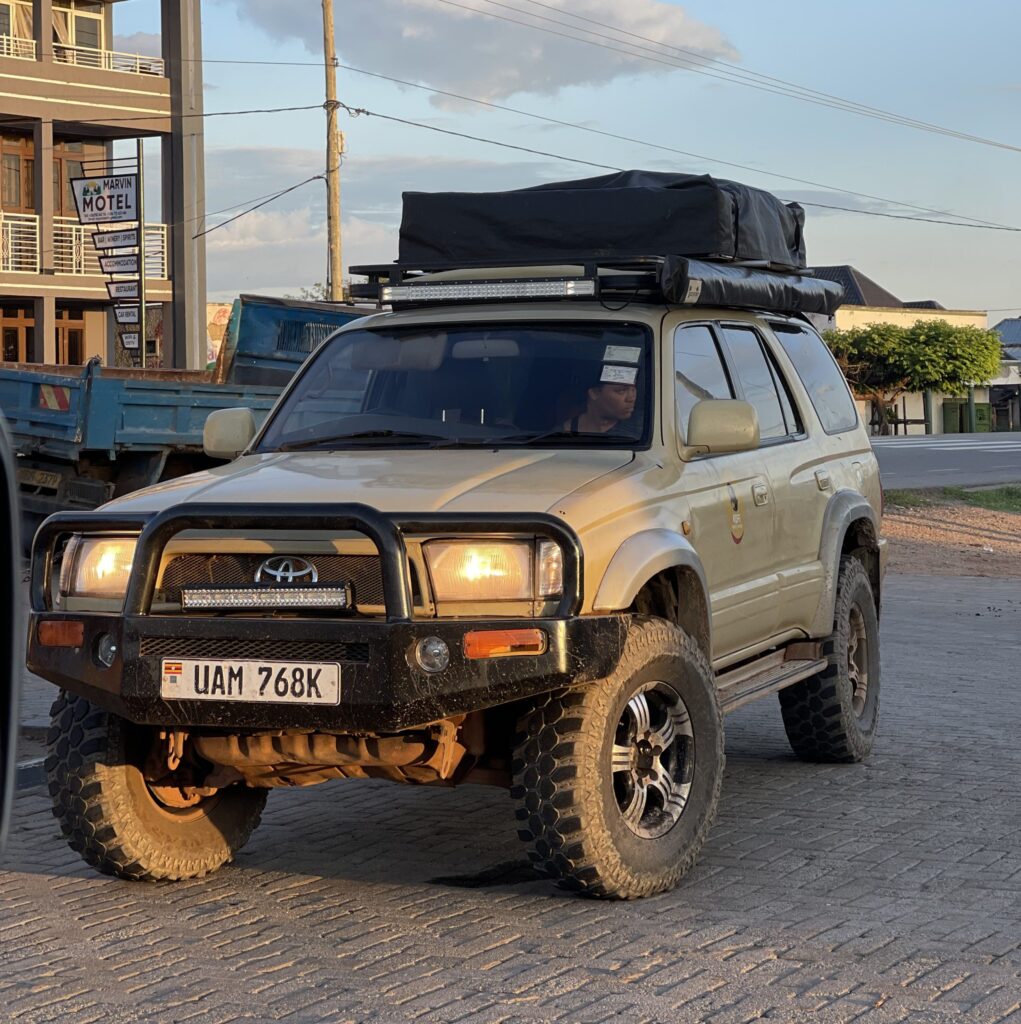
Toyota Surf Rental with Rooftop Tent in Uganda
| QUICK FACTS
Vehicle: Toyota Surf / 4Runner, 4×4, diesel, seats 4–5 Daily rate: approx. USD 80 – 140 self-drive with rooftop tent & full camping kit Best for: Murchison Falls, Queen Elizabeth, Kidepo Valley, Lake Mburo, Bwindi approach roads Requires: Valid driving licence 25+, refundable security deposit, passport copy |
Why the Toyota Surf Is Uganda’s Favourite Self-Drive Overlander
If you have scrolled through overlanding forums or Uganda safari Facebook groups, one vehicle keeps appearing in the photos: a mud-splattered Toyota Surf with a canvas rooftop tent folded open above the rear window, parked beside a campfire somewhere between Murchison Falls and the Rwenzori foothills. The Toyota Surf, sold internationally as the 4Runner, has built a reputation across East Africa as the sweet spot between a nimble RAV4 and a heavy-duty Land Cruiser — tough enough for red-clay tracks and river crossings, yet light and fuel-efficient enough to keep a two-week road trip affordable.
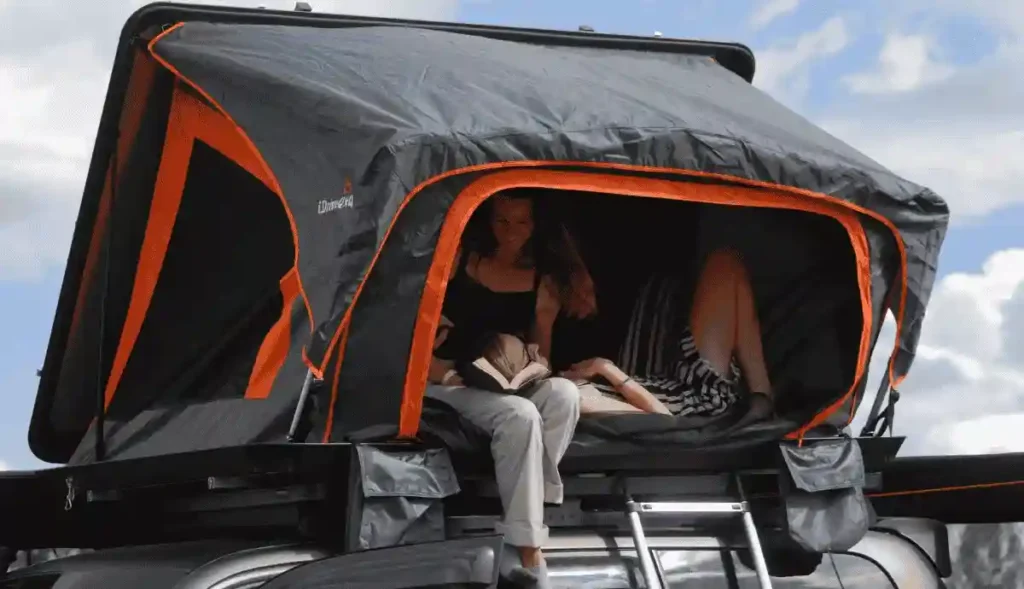
Renting a Toyota Surf fitted with a rooftop tent turns a standard self-drive itinerary into a full expedition. Instead of pre-booking lodges months in advance and staying tied to fixed overnight stops, you carry your accommodation with you — pulling off the road wherever a campsite, community site, or park-authorised bush camp allows, popping the tent open in under five minutes, and waking up to birdsong instead of a hotel corridor.
This guide walks through everything you need before booking a Toyota Surf rooftop-tent rental in Uganda: the vehicle’s real-world capabilities, what a rental package typically includes, honest pricing, the best routes to use it on, and the practical paperwork that keeps a border crossing or ranger checkpoint stress-free.
What Exactly Is the Toyota Surf?
A rebadged icon. The Toyota Surf is the Japanese-market name for the Toyota 4Runner, a mid-size body-on-frame SUV built on the same platform as the Hilux pickup. Because Uganda’s used-vehicle market imports heavily from Japan, “Surf” is the name that stuck locally, even though the same vehicle is called the 4Runner in the United States and parts of Southern Africa.
Most Surfs available for rental in Uganda are third or fourth-generation models (roughly 1995–2009), fitted with a 3.0L turbo-diesel or 2.7L petrol engine, selectable 4WD with high and low range, and a rear differential lock on higher trims. Ground clearance typically sits around 200–225mm — enough to clear the eroded sections of the Ishasha track in Queen Elizabeth National Park or the black-cotton soil roads north of Murchison Falls after rain, situations that regularly strand smaller crossovers.
Typical Toyota Surf Specifications for Rental Fleets
| Specification | Typical Value |
| Engine | 3.0L turbo-diesel (1KZ-TE) or 2.7L petrol (3RZ-FE) |
| Drivetrain | Part-time 4WD, high/low range transfer case |
| Seating | 5 seats (4 comfortable with camping gear loaded) |
| Ground clearance | ≈ 200–225 mm |
| Fuel tank | ≈ 87 litres |
| Approx. fuel economy | 9–11 km/litre (mixed tarmac & dirt) |
| Roof load rating | Sufficient for a hard-shell or soft-shell rooftop tent (2-person) |
| Transmission | Manual or automatic, depending on unit |
Why Add a Rooftop Tent Instead of Booking Lodges?
Rooftop-tent self-drive is not simply a budget option — although it typically undercuts a mid-range lodge circuit by a wide margin. It is a different style of travel entirely, and it suits a specific kind of traveler.
- Cost efficiency: a rooftop tent replaces 10–20 nights of accommodation, often the single biggest line item in an East Africa itinerary.
- Flexibility: no need to lock in a fixed route months ahead; if Kidepo’s roads are impassable or you fall in love with Lake Mburo, you simply stay another night.
- Elevated comfort and safety: sleeping 1.2–1.5 metres off the ground keeps you away from insects, snakes, and inquisitive wildlife that ground tents are more exposed to.
- Speed of setup: most rooftop tents unfold and are ready to sleep in within 3–5 minutes, and pack down almost as fast — useful when you are chasing the last light before a park gate closes.
- Built-in mattress and bedding: unlike ground camping, you are not carrying, inflating, or packing a separate sleeping pad each night.
What’s Typically Included in a Toyota Surf Rooftop Tent Package
Rental operators in Uganda generally bundle camping equipment into the vehicle package rather than charging separately for each item, though it is worth confirming the exact list in writing before you sign the rental agreement. A well-equipped Toyota Surf rooftop tent rental usually includes:
- A 2-person rooftop tent (canvas soft-shell or hard-shell) with integrated foam mattress
- Access ladder and rainfly / weather cover
- Camping table and two to four folding chairs
- Portable fridge or cool box, often powered from the vehicle’s second battery
- Gas cooker or two-burner stove with a spare gas canister
- Basic cookware, plates, cups, and cutlery
- Two jerry cans for extra fuel and one for drinking water
- A roof-mounted or side-mounted awning on some units
- A spare tyre (often two on longer rentals), jack, and full tool kit
- Comprehensive insurance and 24-hour roadside assistance
| GOOD TO CONFIRM BEFORE YOU SIGN
Whether unlimited mileage is included, or whether there is a daily km cap with an excess charge Whether the security deposit is refundable in cash, or held on a card pending vehicle return Whether cross-border travel into Rwanda, Kenya, or Tanzania is permitted, and whether a COMESA yellow card and letter of authorization are provided Condition of tyres and spare — ask for recent photos if booking remotely |
Toyota Surf Rooftop Tent Rental Prices in Uganda
Pricing varies by operator, vehicle age, season, and rental length, but the ranges below reflect what independent travelers can typically expect to budget for a self-drive Toyota Surf with full rooftop tent and camping equipment in 2026. Longer rentals almost always unlock a lower daily rate, and most operators offer a discount once a booking crosses the two- to three-week mark.
| Rental Length | Approx. Daily Rate (USD) | Notes |
| 1–6 days | USD 120 – 140 / day | Short trips, standard mileage cap |
| 7–13 days | USD 100 – 120 / day | Most common range for a single-country circuit |
| 14–20 days | USD 90 – 110 / day | Suits a multi-park Uganda loop |
| 21+ days | USD 80 – 100 / day | Best value; often used for cross-border East Africa trips |
On top of the daily rate, budget for a refundable security deposit (commonly USD 500–1,500 depending on the operator and vehicle age), park entrance fees and vehicle fees payable directly to Uganda Wildlife Authority at each national park gate, fuel, and any cross-border permits if the itinerary extends into Rwanda, Kenya, or Tanzania.
Best Uganda Routes for a Toyota Surf Rooftop Tent Trip
Murchison Falls National Park
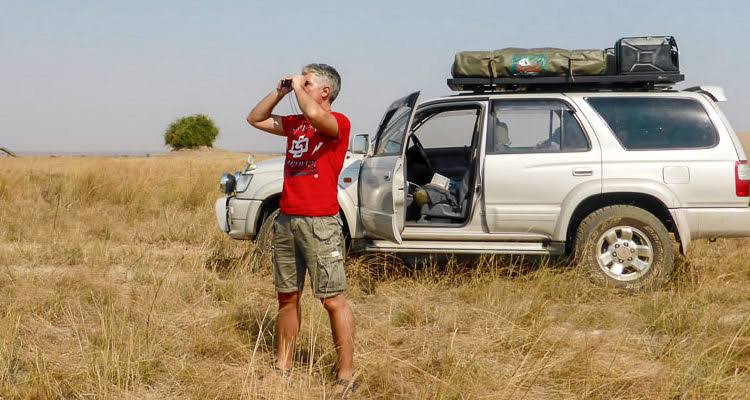
The drive north from Kampala via Masindi puts you at the top of Uganda’s largest national park, where the Victoria Nile is compressed through a narrow gorge before exploding over the falls. The Surf’s clearance is genuinely useful here — the delta track and the routes toward Chobe can turn to thick mud in the rainy season. Community and UWA-run campsites near Paraa and along the Buligi circuit allow rooftop tent camping.
Queen Elizabeth National Park
The Ishasha sector, famous for tree-climbing lions, sits on a rough, rutted track that rewards a 4×4 with real ground clearance. Rooftop-tent-friendly campsites are dotted around Mweya, Ishasha, and the Kyambura Gorge area, making a multi-night loop through the park straightforward without repacking the vehicle each stop.
Kidepo Valley National Park
Uganda’s most remote park, tucked against the South Sudan and Kenyan borders in Karamoja, is where a rooftop tent setup earns its keep. Lodge options are limited and expensive; a self-contained Surf with camping gear lets you spend several nights inside this semi-arid, dramatically beautiful landscape without depending on scarce accommodation.
Lake Mburo National Park
The closest park to Kampala, and an easy shakedown trip for travellers testing their rooftop tent setup before heading further afield. Zebra, eland, and impala wander close to the campsites, and the shorter driving distances make it forgiving for a first self-drive attempt.
Bwindi and Rwenzori Approach Roads
While gorilla trekking itself doesn’t require a rooftop tent, the drive into the Bwindi and Rwenzori foothills crosses steep, switchback murram roads where the Surf’s 4WD low range and compact wheelbase are a real advantage over larger, longer-wheelbase vehicles.
Sample 7-Day Toyota Surf Rooftop Tent Itinerary
| Day | Route | Overnight |
| 1 | Entebbe / Kampala → Lake Mburo National Park | Rooftop tent, Lake Mburo campsite |
| 2 | Lake Mburo → Queen Elizabeth National Park (via Mbarara) | Campsite near Mweya or Ishasha |
| 3 | Ishasha sector game drive → Kyambura Gorge area | Campsite, Kyambura area |
| 4 | Queen Elizabeth → Fort Portal (Crater Lakes) | Campsite near Fort Portal |
| 5 | Fort Portal → Kibale Forest → Murchison Falls (long day) | Campsite near Paraa |
| 6 | Murchison Falls game drive, boat cruise to the Falls | Campsite near Paraa |
| 7 | Murchison Falls → Kampala / Entebbe | Return vehicle, drop-off |
Booking Requirements & Documents
- A valid driving licence, generally held for a minimum of 2–5 years depending on the operator’s policy
- International Driving Permit recommended, though a national license in English is often accepted
- Minimum age of 23–25 years, sometimes with a young-driver surcharge below 25
- A copy of your passport and, for some operators, a second form of ID
- Refundable security deposit, paid in cash or held on a credit card
- Signed rental agreement outlining mileage limits, fuel policy, and insurance excess
- COMESA yellow card and letter of authorization if the trip crosses into Rwanda, Kenya, Tanzania, or DR Congo
Practical Tips for Self-Driving a Toyota Surf in Uganda
- Fill the tank whenever you pass a reliable station — fuel stops thin out considerably north of Masindi and around Kidepo.
- Engage 4WD high range proactively on murram roads during the rainy season (March–May and September–November) rather than waiting until you are already stuck.
- Practise folding the rooftop tent once at the rental yard before you leave, ideally with the operator watching, so you are confident doing it alone at a campsite in fading light.
- Carry printed copies of your booking confirmation, driving licence, and passport — checkpoints and park gates are more common outside Kampala.
- Book UWA park entry and camping fees in advance where possible, and always carry the receipt.
- Keep a paper map or offline GPS app as backup; mobile signal drops out completely in parts of Kidepo and the Ishasha sector.
| SAFETY NOTE
Check regional travel advisories before finalising a cross-border route, particularly near the DR Congo and South Sudan borders. Always camp only at designated or ranger-approved sites within national parks, and never leave the vehicle unattended with the rooftop tent open at unmarked roadside stops. |
Frequently Asked Questions
Is a Toyota Surf better than a RAV4 for Uganda self-drive?
For tarmac-focused itineraries or shorter trips confined to accessible parks, a RAV4 is cheaper and perfectly capable. The Surf earns its higher rental cost on routes with river crossings, steep murram switchbacks, or extended off-road sections such as Kidepo, Ishasha, or the Murchison delta track, where its ground clearance and low-range gearing matter.
Can one person set up the rooftop tent alone?
Yes. Most soft-shell rooftop tents fitted to Surf rentals in Uganda are designed for solo setup in a few minutes, using a gas-strut assisted lid and a fold-out ladder. It is still worth doing a practice run at the rental yard before departure.
Do I need a driver-guide, or can I really self-drive?
Self-drive is legal and common for travellers with prior 4×4 experience, but operators also offer the same Toyota Surf rooftop tent package with a driver-guide for those who prefer not to navigate Uganda’s roads and park tracks independently.
What happens if the vehicle breaks down in a remote park?
Reputable rental operators include 24-hour roadside assistance and will dispatch a replacement vehicle or mechanic; this is one of the most important things to verify — along with response times to remote areas — before booking.
Final Thoughts
A Toyota Surf with a rooftop tent strikes a rare balance for Uganda travel: capable enough for the country’s roughest park tracks, efficient enough to keep fuel costs reasonable, and flexible enough to let a two- or three-week itinerary evolve as you go. Whether the plan is a focused week through the western parks or a full cross-border overland loop through Rwanda and Kenya, booking the right vehicle and package — with clear terms on mileage, insurance, and camping gear — is the single biggest factor in how smoothly the trip runs.