
Driving in Rwanda and Uganda: The Complete 2026 Guide for Self-Drive Travelers
Road rules, driving sides, permits, road conditions, vehicle choice, border crossing, and safety tips for anyone planning a self-drive road trip through Rwanda and Uganda.
Driving in Rwanda and Uganda, Rwanda and Uganda sit at the heart of East Africa’s gorilla-trekking and Great Lakes safari circuit, and more travelers than ever are choosing to explore both countries behind the wheel of their own 4×4. But driving in Rwanda and Uganda is not the same experience — the two neighbors drive on opposite sides of the road, enforce different speed limits, and require different paperwork the moment you cross the border. This guide walks through everything a self-drive traveler needs to know: licensing, road conditions, vehicle choice, border-crossing procedures, and the safety habits that keep a road trip through the Virunga foothills and Uganda’s savannah parks smooth from start to finish.
| Quick Facts
Rwanda: drives on the RIGHT-hand side of the road, steering wheel on the left. Uganda: drives on the LEFT-hand side of the road, steering wheel on the right. Speed limits: Uganda 50 km/h in trading centers, 80 km/h on highways. Rwanda 60 km/h nationwide with speed cameras. Border crossings: Gatuna/Katuna (Kabale) and Cyanika/Kagitumba near the Virunga side are the main tourist crossings. |
The Single Biggest Adjustment: Rwanda and Uganda Drive on Opposite Sides
The first thing every self-drive traveler must plan for is the switch in road orientation at the border. Rwanda follows continental convention and drives on the right-hand side of the road, with the steering wheel positioned on the left of the vehicle — the same system used across most of mainland Africa, Europe, and North America. Uganda, a legacy of British colonial rule, drives on the left-hand side, with the steering wheel on the right, the same system used in Kenya, Tanzania, and the UK.
This means that anyone driving a self-owned or one-way rental vehicle across the Rwanda–Uganda border must consciously reset their instincts the moment they cross — particularly at roundabouts, when overtaking, and when judging oncoming traffic on narrow mountain roads. Rental vehicles based in Rwanda are left-hand drive; rental vehicles based in Uganda are right-hand drive. If you are hiring one vehicle for a trip that spans both countries, confirm with the rental company which side of the border the car is registered and insured for, since driving a right-hand-drive Ugandan vehicle in Rwanda (or vice versa) is legal but takes real adjustment.
Practical tips for the switch
- Slow down at every roundabout for the first day after crossing — roundabout right-of-way rules and lane positioning feel reversed.
- Say the rule out loud: “Right in Rwanda, left in Uganda” — a simple verbal cue reduces the chance of instinctively drifting to the wrong side after a rest stop.
- Avoid overtaking on the first few kilometers after a border crossing until your instincts have caught up.
- Passengers should help, watching the mirrors and calling out lane position, especially in the first hour of driving on the “new” side.
Licenses, Permits, and Paperwork
Whether you plan to self-drive with your own rental or hire a car with a driver, you need the right documentation before you leave home — and additional paperwork if you plan to cross the border with the vehicle.
Driving License Requirements
| Traveler type | Rwanda | Uganda |
| EAC nationals (Kenya, Tanzania, Rwanda, Uganda, Burundi, South Sudan, DRC) | National license accepted | National license accepted, no IDP required |
| Latin-script foreign license (UK, US, EU, etc.) | Accepted for up to 3 months | Accepted, but IDP strongly advised |
| Non-Latin-script license (Arabic, Chinese, Russian, etc.) | IDP required | IDP required |
| Renting from a private car hire company | IDP usually requested regardless of nationality | IDP usually requested regardless of nationality |
In practice, carry an International Driving Permit (IDP) even if your license technically qualifies without one. It translates your license into multiple languages, speeds up interactions at police checkpoints, and is a standard requirement of almost every reputable car rental company in both countries. Apply for an IDP from your home country’s motoring association before you travel — it cannot be obtained locally.
Documents to Carry at All Times
- Valid passport with at least six months’ validity remaining
- Correct visa — the East African Tourist Visa covers Rwanda, Uganda, and Kenya on a single entry and is the most convenient option for a multi-country road trip
- National driving license and International Driving Permit
- Vehicle registration / logbook (or rental agreement if using a hired car)
- Proof of insurance
- Rental company contact details and any authorization letters
Cross-Border Vehicle Documents
If you intend to drive the same rental vehicle across the Rwanda–Uganda border rather than hiring separately in each country, additional paperwork is mandatory. Not every rental company permits this, so confirm cross-border terms before booking.
| Document | Purpose |
| Letter of Authority | Written permission from the rental company allowing the vehicle to leave the country of registration |
| COMESA Yellow Card | Regional third-party insurance sticker valid across East and Southern African member states — mandatory for cross-border driving |
| Temporary Import / Export Permit | Issued by customs at the border, allowing the foreign-registered vehicle to enter or temporarily leave the country |
| Vehicle logbook copy | Proof of ownership or registration, checked by customs officials at the border post |
| Book With a Cross-Border Specialist
Only some car hire companies in Rwanda and Uganda are licensed and insured for cross-border travel. Book with an agency that explicitly advertises cross-border or one-way rentals, disclose your full route at the time of booking, and never attempt to cross without written authorization — an unauthorized crossing risks vehicle impoundment, voided insurance, and personal liability for any accident or damage. |

Driving in Rwanda: Roads, Rules, and Road Manners
Rwanda has earned a reputation as one of the best-maintained road networks in East Africa. The country’s compact size, hilly terrain, and disciplined traffic culture — Kigali is famously clean and orderly — make it one of the more relaxed places in the region to self-drive, though the mountainous roads demand full attention.
Road Conditions
- Paved highways: Kigali is connected to Musanze (Volcanoes National Park), Huye, Rubavu (Lake Kivu), and Rusizi by well-maintained tarmac roads.
- Mountain roads: routes toward Volcanoes National Park and the Congo-Nile Divide wind through steep, terraced hillsides with frequent switchbacks — beautiful but slow going, especially in fog or rain.
- Rural and park-access roads: expect graded gravel and dirt tracks once you leave the main highway network, particularly around Nyungwe Forest and rural Eastern Province.
- Roundabouts: common throughout Kigali and provincial towns. Traffic already inside a roundabout always has right of way.
Rules and Enforcement
- Speed limit: 60 km/h nationwide as a general rule, enforced by a dense network of speed cameras — Rwanda is strict, and fines are issued automatically.
- Seatbelts: mandatory for driver and all passengers, front and back.
- Mobile phones: hands-free use only — holding a phone while driving is a punishable offense.
- Motorcycle helmets: mandatory for both rider and passenger if you use a moto-taxi.
- Alcohol: zero-tolerance enforcement is strict; do not drink and drive.
- Police checkpoints: routine and courteous — have your documents accessible and be prepared to show your license, IDP, and vehicle papers.
3.3 Kigali City Driving
Kigali’s roads are smooth, well-signed, and increasingly organized with dedicated lanes, but the city’s hills mean sharp gradients and blind crests are common. Car parks and one-way systems are well marked. Traffic builds during the morning and evening rush (roughly 7–9 a.m. and 5–7 p.m.), but nothing like the gridlock found in Kampala or Nairobi.
Driving in Uganda: Roads, Rules, and Road Manners
Uganda is often described as the most affordable self-drive destination in East Africa, but its roads demand more experience than Rwanda’s. Outside the main highways, expect potholes, unmarked speed bumps, and a livelier mix of traffic — from long-distance trucks to boda-boda motorcycle taxis weaving between lanes.
Road Conditions
- Major highways: tarmac roads link Kampala to Entebbe, Jinja, Mbarara, Fort Portal, and Gulu, though surface quality varies and potholes appear even on primary routes after heavy rain.
- National park roads: routes into Murchison Falls, Queen Elizabeth, Kibale, and Bwindi are a mix of tarmac and graded murram (dirt) roads — a high-clearance 4×4 is strongly recommended, especially in the wet season.
- Boda-bodas: motorcycle taxis are everywhere and often weave unpredictably between vehicles; give them a wide, patient berth rather than reacting suddenly.
- Speed bumps and trading centers: unmarked bumps are common when entering small towns; slow down proactively rather than braking hard at the last second.
Rules and Enforcement
- Speed limit: 50 km/h in trading centers and towns, 80 km/h on the open highway, and 40 km/h inside national parks, where animals have the right of way.
- Park speeding fines: violations inside national parks are fined on the spot and must typically be paid before you are allowed to exit the park.
- Seatbelts and phones: seatbelt use is mandatory; hand-held phone use while driving is prohibited.
- Honking as courtesy: Ugandan drivers commonly hoot briefly to signal their presence when overtaking or approaching a blind corner — it is a courtesy, not an act of aggression.
- Night driving: avoid it outside major towns. Poor lighting, unmarked hazards, pedestrians, and wildlife crossings make rural night driving genuinely risky.
Kampala City Driving
Kampala’s traffic is considerably heavier and less predictable than Kigali’s, with congestion peaking on weekday mornings and evenings. If your itinerary allows it, plan to enter or exit Kampala outside rush hour, and budget extra time for any errands or vehicle collection within the city.
Crossing the Rwanda–Uganda Border by Road
The two countries share several official land border crossings, but tourists driving between the gorilla-trekking regions of both countries almost always use one of two crossings: Gatuna (Rwanda) / Katuna (Uganda), near Kabale and Musanze, or Cyanika (Uganda) / Kagitumba, near Mgahinga Gorilla National Park and Volcanoes National Park. Both are well-used by tour operators and generally straightforward, though queues can build when buses or trucks arrive at the same time.
Step-by-Step Border Crossing Process
- Exit formalities: clear immigration on the departing country’s side to have your passport stamped for exit, and present the vehicle’s temporary import/export documents to customs.
- Drive to the neighboring post: the two border posts sit close together — you drive a short distance between them, often through a shared no-man’s-land.
- Entry formalities: clear immigration on the arriving country’s side for an entry stamp, then present your visa (or East African Tourist Visa) if required.
- Vehicle clearance: customs officials check the vehicle’s Letter of Authority, COMESA insurance, and logbook, then issue a temporary import permit for the car.
- Continue your journey: once both immigration and customs formalities are complete on the arriving side, you’re clear to drive on.

Border Crossing Tips
- Arrive with all documents already organized in a single folder — immigration and customs move faster when nothing needs to be searched for.
- Expect delays around midday and when tour buses arrive; early morning crossings tend to be quicker.
- Keep small denominations of local currency and US dollars on hand for any incidental fees.
- Disclose your full cross-border itinerary to your rental company in advance — undisclosed border crossings can void insurance coverage.
- Double-check which side of the road you should be on the moment you clear the second checkpoint, especially if switching between left- and right-hand-drive vehicles.
Choosing the Right Vehicle
Vehicle choice matters more in this region than almost anywhere else in East Africa, because road quality changes dramatically between highway sections and national park access roads.
| Vehicle type | Best for | Notes |
| Compact sedan (Vitz, Fielder) | Kigali and Kampala city use, paved highway trips | Not suitable for park roads or the wet season |
| Mid-size SUV (RAV4, X-Trail) | Highway travel with light gravel sections | Comfortable, good fuel economy, limited ground clearance |
| 4×4 (Land Cruiser, Prado, Hilux) | National park roads, mountain routes, cross-border trips | The standard choice for gorilla trekking and multi-park itineraries |
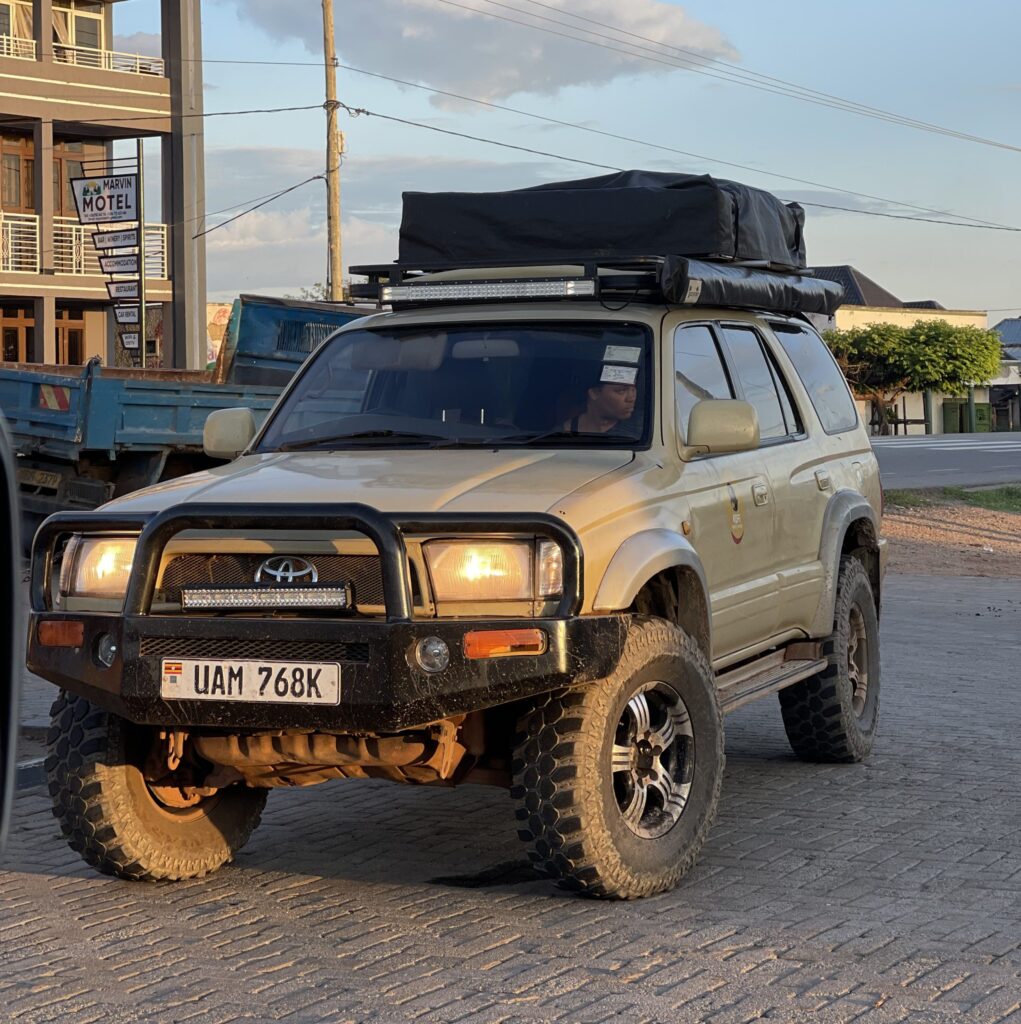
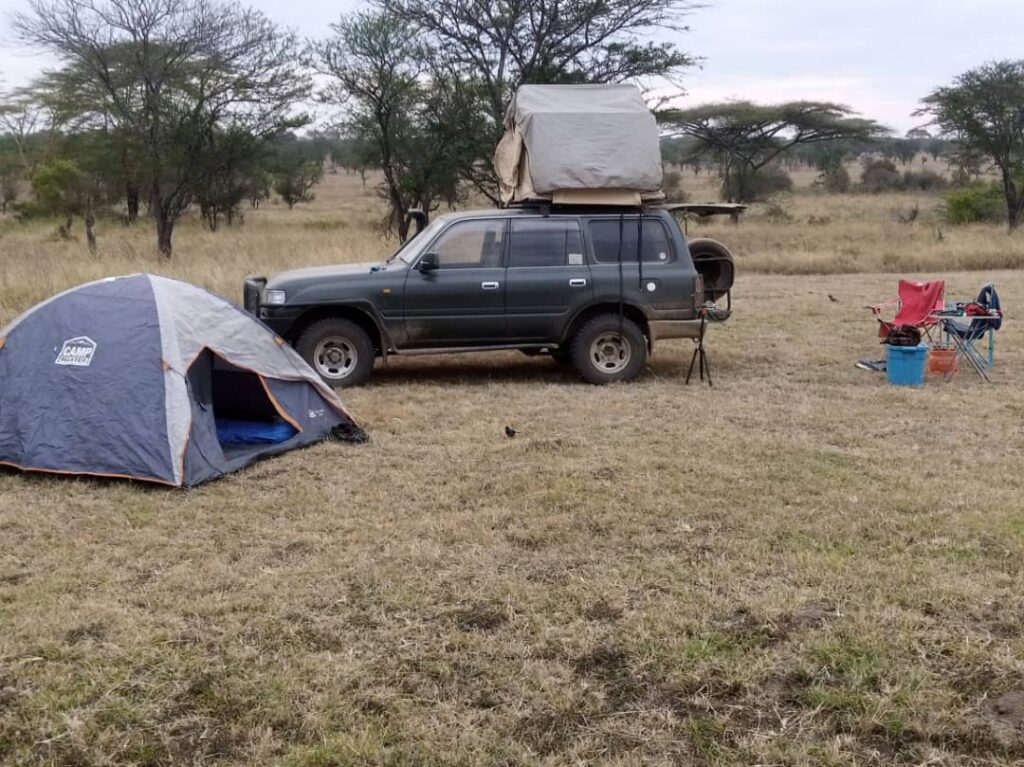
| 4×4 with rooftop tent | Self-drive campers combining parks in both countries | Adds flexibility for overnight stops between destinations |
| Self-Drive or Hire a Driver?
Self-drive suits travelers confident switching sides of the road and comfortable with mountain driving and basic off-highway conditions — it offers maximum flexibility and is generally the cheaper option. Car with driver removes the stress of the left/right switch entirely, comes with a driver who knows the checkpoints and border process, and is especially worth considering for gorilla-trekking routes with early starts and long mountain drives. |
Safety, Weather, and Practical Driving Tips
Seasonal Considerations
Both countries have two rainy seasons — roughly March to May and September to November — during which murram and dirt roads deteriorate quickly and can become impassable without a 4×4. If your trip falls in the wet season, build extra time into your itinerary and avoid tight same-day border-crossing-and-trekking schedules.
General Safety Tips
- Carry extra fuel and drinking water on rural or park routes, as fuel stations thin out away from major towns.
- Download offline maps before departure — mobile signal is unreliable in mountainous and park areas.
- Keep a safe following distance; sudden stops for pedestrians, livestock, or potholes are common on both sides of the border.
- Avoid rural night driving in both countries — poor lighting and unmarked hazards significantly raise the risk.
- Inside national parks, respect the 40 km/h limit and animal right-of-way — fines are issued on the spot and payable before you can exit the park.
- Keep your documents (license, IDP, registration, insurance) organized and easily accessible for checkpoints.
Fuel and Currency
- Rwanda: fuel is priced in Rwandan francs (RWF); fuel stations are reliable in Kigali and provincial towns, sparser near remote park entrances.
- Uganda: fuel is priced in Ugandan shillings (UGX); major towns are well served, but always top up before heading into rural or park areas.
- Carry cash in both local currencies plus US dollars, since card acceptance is inconsistent outside major cities.
Frequently Asked Questions
Do I need an International Driving Permit for both countries?
It is not always legally mandatory depending on your nationality and license type, but it is strongly recommended and frequently requested by rental companies and at police checkpoints in both Rwanda and Uganda.
Can I drive the same rental car across the Rwanda–Uganda border?
Yes, but only with a rental company that explicitly permits and is licensed for cross-border travel, and only with the correct paperwork — a Letter of Authority, COMESA insurance, and a temporary import/export permit.
Which side of the road does each country drive on?
Rwanda drives on the right; Uganda drives on the left. This is the single most important adjustment for anyone driving across the border.
Is self-driving safe for first-time visitors to East Africa?
Many first-time visitors self-drive successfully, particularly in Rwanda’s well-organized road network. Uganda’s roads and traffic mix require more experience; hiring a driver for at least the Ugandan legs of a trip is a common and sensible compromise.
What is the East African Tourist Visa?
A single-entry visa covering Rwanda, Uganda, and Kenya, purchased once for all three countries — a convenient option for travelers planning a multi-country road trip through the region.