
40-Day Uganda 4×4 Rooftop Tent Self-Drive Itinerary
40-Day Uganda 4×4 Rooftop Tent Self-Drive Itinerary, Uganda is the most biodiverse country per square kilometre in Africa, home to more than half the world’s remaining mountain gorillas, the greatest concentration of primates on Earth, the world’s most powerful waterfall, and landscapes so varied you can wake to equatorial rainforest and camp under semi-arid skies the same day. A 4×4 rooftop tent self-drive safari through Uganda is the ultimate way to experience this extraordinary country: the freedom to camp where the wildlife is, access roads that conventional vehicles cannot manage, and the intimacy of sleeping elevated above the African bush with panoramic views that no lodge can replicate.

This 40-day Uganda self-drive itinerary covers every major national park and key destination – from the remote Kidepo Valley on the South Sudanese border to the volcanic Mgahinga in the extreme southwest, from the rainforests of Kibale to the ancient Mountains of the Moon. You will encounter mountain gorillas multiple times, chimpanzees in three different habitats, tree-climbing lions, white rhinos, elephants, and over 1,000 bird species. Approximately 4,200 km of Uganda’s red laterite tracks, tarmac highways, and riverside sand tracks will test both your 4×4 and your sense of adventure.
Trip Planning Essentials
| Start / End Point | Kampala, Uganda (Entebbe International Airport – EBB) |
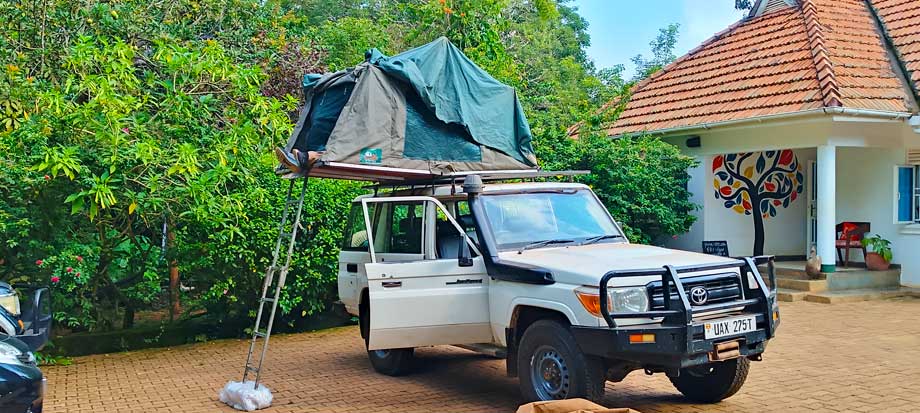
| Recommended Vehicle | 4×4 Toyota Land Cruiser 76 Series or Toyota Hilux Double Cab with rooftop tent |
| Rooftop Tent | Alu-Cab or RoofNest 2-person tent with ladder and built-in mattress |
| Total Distance | Approximately 4,200 km (mix of tarmac, murram & 4WD tracks) |
| Best Travel Season | Dry seasons: June–September and December–February |
| Gorilla Permits | USD 800/person – book 6–12 months in advance (UWA Kampala) |
| Chimp Permits | Kibale USD 250 | Budongo USD 90 | Kyambura USD 50 |
| Recommended Fuel Range | Always maintain 40+ litres reserve; carry a 20L jerry can |
| Travel Insurance | Essential – include medical evacuation, off-road, and wildlife cover |
| Uganda e-Visa | Apply at visas.immigration.go.ug – single entry USD 50 |
| Vaccinations | Yellow fever (mandatory), hepatitis A/B, typhoid, rabies recommended |
| Currency | Uganda Shillings (UGX) – USD cash also widely accepted |
| 🚗 Essential 4×4 Rooftop Tent Equipment Checklist
Recovery: High-lift jack, 2× recovery boards (MaxTrax), tow strap, shackles, shovel Navigation: Offline Uganda maps (Gaia GPS / Maps.me), handheld GPS, road atlas Camping: Rooftop tent (pre-fitted), sleeping bags (15°C rating), camp chairs & table, cooking stove, pot set, cooler box (12V) Safety: First aid kit, satellite communicator (Garmin inReach), fire extinguisher, reflective triangle Spares: 2× full spare tyres, engine oil 5L, coolant 2L, basic tool kit, puncture repair kit, fan belt Documents: Driving permit, vehicle logbook, insurance, park passes, gorilla/chimp permits printed |
40-Day Route Overview by Week
| Week 1 – Days 1–7 | Kampala → Jinja → Sipi Falls → Kidepo Valley NP |
| Week 2 – Days 8–14 | Gulu → Murchison Falls NP → Budongo Forest → Ziwa Rhinos → Lake Mburo |
| Week 3 – Days 15–21 | Bwindi Impenetrable NP → Ishasha → Queen Elizabeth NP → Fort Portal |
| Week 4 – Days 22–28 | Kibale NP → Semuliki NP → Rwenzori Mountains NP → Kasese |
| Week 5 – Days 29–33 | Lake Bunyonyi → Mgahinga Gorilla NP → Kabale → Kigezi Highlands |
| Week 6 – Days 34–40 | Bwindi Nkuringo → QENP Ishasha → Kampala → Entebbe → Departure |
Day-by-Day Itinerary
WEEK 1: KAMPALA, JINJA, SIPI FALLS & KIDEPO VALLEY (Days 1–7)
| DAY 1 | Kampala – Vehicle Collection & City Orientation |
| 🚗 Drive: 0 km (city) ⛺ Camp: Kampala – Cassia Lodge Campsite or Red Chilli Rest Camp
★ Highlights: Vehicle handover, rooftop tent setup, Gaddafi Mosque, Kampala city walk |
|
| Arrive at your rental depot in Kampala to collect your 4×4 Land Cruiser or Toyota Hilux fitted with a rooftop tent, recovery kit, and all camping essentials. Spend the morning going through the vehicle checklist, calibrating the rooftop tent mechanism, and meeting your rental coordinator. In the afternoon, explore Kampala’s hilly streets: visit the Bahá’í Temple atop Kikaya Hill, Kasubi Tombs (UNESCO), and the lively Nakasero Market. End the day setting up camp at Red Chilli Rest Camp (Banda) – the classic base for self-drivers – and enjoy a cold Nile Special under the trees.
💡 Tip: Calibrate your GPS and download offline Uganda maps (Maps.me or Gaia GPS) before leaving the depot. |
|

| DAY 2 | Kampala to Jinja – Source of the Nile |
| 🚗 Drive: 82 km / 1.5 hrs ⛺ Camp: Jinja – Nile Camp or Adrift Riverside Camp
★ Highlights: Source of the Nile boat ride, Owen Falls Dam view, Bujagali Falls, white-water rafting (optional) |
|
| After a light breakfast strike east along the Kampala–Jinja highway. At Jinja, pull into the Source of the Nile gardens where the Victoria Nile begins its 6,650 km journey to the Mediterranean. Take the short boat ride to the exact source point, then drive to the Bujagali dam viewpoint. Keen adventurers can book an afternoon white-water rafting session on the Class IV Nile rapids with Adrift or Nile River Explorers. Set up your rooftop tent at riverside camp while listening to the thundering Nile.
💡 Tip: Book rafting 48 hrs in advance – mornings fill up fast especially November to February. |
|
| DAY 3 | Jinja to Sipi Falls – Slopes of Mt Elgon |
| 🚗 Drive: 175 km / 3.5 hrs ⛺ Camp: Sipi River Lodge Campsite or Crows Nest Camp
★ Highlights: Sipi Falls triple cascade trek, coffee farm tour, Kalimba Reptile Park (en route) |
|
| Head northeast through Mbale onto the foothills of Mt Elgon, Africa’s fourth-highest volcano. The road climbs through terraced coffee and banana gardens to reach Sipi Falls at 1,800 m. Three cascades tumble down the escarpment; the main fall drops 100 m into a misty gorge. Hike to the base of all three falls with a local guide (2–3 hrs). In the evening join a sunset coffee-washing tour on a Sipi arabica farm – Uganda’s finest beans come from here.
💡 Tip: The road from Mbale to Sipi has steep corners – take switchbacks in low range 4WD. |
|
| DAY 4 | Sipi Falls – Full Day Exploration & Mt Elgon Foothills |
| 🚗 Drive: 40 km loop ⛺ Camp: Crows Nest Camp, Sipi
★ Highlights: Waterfall abseiling, cave exploration, rock-art sites, Bagisu cultural village |
|
| Spend a second day exploring the Mt Elgon ecosystem. Join a guided abseil down the main Sipi waterfall face – a 100 m vertical drop that ends in the gorge pool. In the afternoon drive a loop through Kapchorwa town to explore Bagisu culture: witness the kween (circumcision initiation songs) or visit local pottery workshops. The caldera rim of Mt Elgon National Park starts just above camp – request a ranger for the Sasa Trail hike to the first camp point.
💡 Tip: Abseiling is bookable at Sipi River Lodge – helmets and harnesses provided; all fitness levels welcome. |
|
| DAY 5 | Sipi Falls to Kidepo Valley National Park – Karamoja Wilderness |
| 🚗 Drive: 310 km / 6–7 hrs ⛺ Camp: Apoka Tourist Camp – Rooftop Tent on Designated Camping Pitch
★ Highlights: Karamoja semi-arid plains, Dodoth cattle herders, Apoka rock viewpoint, night sounds |
|
| This is one of Uganda’s great overland drives. Head north through Moroto town, deep into the Karamoja region – a vast semi-arid plateau rolling to the Sudanese and South Sudanese borders. The landscape transitions from lush highlands to Acacia savanna where Karamojong warriors still walk with cattle and spears. Reach Kidepo Valley NP – Uganda’s remotest and most spectacular park – by late afternoon. Set up camp at Apoka and watch buffaloes graze at the waterhole as the blood-red Narus Valley sky dims.
💡 Tip: Fuel up fully in Moroto (last reliable petrol station before Kidepo). Carry 40+ litres extra. |
|
| DAY 6 | Kidepo Valley NP – Full Day Game Drive (Narus Valley) |
| 🚗 Drive: 80 km game drive ⛺ Camp: Apoka Tourist Camp – Rooftop Tent
★ Highlights: Lion, cheetah, Nile lechwe, oribis, elephants, secretary birds, Karamoja apalis |
|
| Rise before dawn for a 6 am game drive into the Narus Valley floodplain – Kidepo’s wildlife heartland. Kidepo is one of Africa’s last truly wild parks: no tourist crowds, no paved roads, and species found nowhere else in Uganda – cheetah, greater kudu, Chandler’s mountain reedbuck, and the Emu-wren-like Karamoja apalis. Lion sightings are frequent. In the afternoon climb Apoka Rock for panoramic views over the valley into South Sudan and return for sundowners from your rooftop tent ladder.
💡 Tip: Hire a park ranger guide – UGX 30,000/day – for superior wildlife spotting and safety. |
|
| DAY 7 | Kidepo Valley NP – Kidepo River Gorge & Cultural Village |
| 🚗 Drive: 60 km ⛺ Camp: Apoka Tourist Camp – Rooftop Tent
★ Highlights: Kidepo dry river bed game walk, Ngikelea community visit, ostrich, hartebeest |
|
| Drive northwest to the Kidepo River – a sandy seasonal river bed lined with borassus palms. In the dry season you can drive along the river bed itself. Watch for ostriches, bat-eared foxes, and large elephant herds that dig for water in the sand. In the afternoon visit the Ngikelea community manyatta (traditional homestead) to meet Karamojong pastoralists and purchase hand-beaded jewellery. Opt for a night game drive (extra cost) to spot genet cats, spotted hyena, and aardvark.
💡 Tip: The Kidepo River drive requires technical 4WD in soft sand – always travel with a recovery board. |
|
WEEK 2: GULU, MURCHISON FALLS, ZIWA RHINOS & LAKE MBURO (Days 8–14)
| DAY 8 | Kidepo to Gulu – Acholi Cultural Capital |
| 🚗 Drive: 295 km / 5 hrs ⛺ Camp: Acholi Inn Campsite, Gulu
★ Highlights: Karamoja plains exit, Pader hills, Gulu town craft market, Lukodi memorial |
|
| Leave Kidepo’s wilderness and drive south-west across Karamoja and into Acholi-land. Gulu – northern Uganda’s largest city – is a vibrant, recovering city once affected by conflict and now famous for incredible cultural hospitality. Visit the Gulu craft market for Acholi barkcloth art and malaika beads. In the evening, visit the Lukodi Community Memorial to learn about northern Uganda’s resilience and transformation. Sleep at the comfortable Acholi Inn campsite.
💡 Tip: The Gulu–Kidepo road passes through Kitgum; stock up on snacks and top up fuel in Kitgum town. |
|
| DAY 9 | Gulu to Murchison Falls NP – Top of the Falls |
| 🚗 Drive: 180 km / 3 hrs ⛺ Camp: Pakuba Safari Lodge Campsite or Red Chilli Camp, Murchison
★ Highlights: Murchison Falls Top of Falls walk, the famous squeeze, Nile panoramas |
|
| Head southwest into Murchison Falls National Park – Uganda’s largest protected area at 3,840 km². Cross the Victoria Nile on the Paraa vehicle ferry (10 am and 2 pm crossings). Drive directly to the Top of the Falls viewpoint where the entire Nile forces itself through a 7-metre gorge in what is scientifically the world’s most powerful rapid. Stand on the spray-soaked rocks above the “Squeeze” for an unforgettable perspective. Set up rooftop camp at Red Chilli Rest Camp on the south bank.
💡 Tip: The Paraa ferry waits for no one – arrive 30 min before departure to guarantee your crossing slot. |
|
| DAY 10 | Murchison Falls NP – North Bank Game Drive (Delta & Budongo) |
| 🚗 Drive: 120 km game drive ⛺ Camp: Red Chilli Camp South Bank
★ Highlights: Elephants, lions, Ugandan kobs, buffaloes, Jackson’s hartebeest, shoebill stork |
|
| Cross on the early ferry to the north bank for a full-day game drive through the Buligi Game Reserve. Murchison’s north bank delivers the best savanna game viewing in Uganda: expect massive elephant herds (1,500+ in the park), lions sleeping in acacia shade, and kobs performing their lek dances. Drive out to the Albert Nile Delta where hippo pods are so dense the river surface disappears. Scan patiently for the prehistoric shoebill stork – one of birding’s Holy Grail species – in the papyrus swamps.
💡 Tip: Bring binoculars and a zoom lens – the delta’s shoebill is usually 50+ metres from the bank. |
|
| DAY 11 | Murchison Falls NP – Nile Boat Cruise (Bottom of Falls) |
| 🚗 Drive: Boat cruise day ⛺ Camp: Red Chilli Camp
★ Highlights: Hippos, crocs, shoebill (boat view), Murchison Falls base view, kingfishers |
|
| Today swap the steering wheel for a boat deck. Join the 3-hour UWA launch cruise from Paraa up the Nile to the bottom of Murchison Falls. The boat weaves through hippo pools (the Nile hosts 2,000+ hippos here), past Nile crocodiles sunning on beaches, and beneath curtains of kingfishers, bee-eaters, and herons. The boat docks at the base of the falls for a 45-minute hike to the top – a steep but spectacular trail through fig forest. In the afternoon do a village walk to Kaniyo Pabidi forest edge.
💡 Tip: Book the 8 am launch for best wildlife activity – book directly at the UWA gate or Paraa Lodge. |
|
| DAY 12 | Murchison Falls NP – Budongo Forest Chimpanzee Habituation |
| 🚗 Drive: Short drive to forest ⛺ Camp: Red Chilli Camp or Budongo Eco Lodge Camp
★ Highlights: Wild chimpanzee tracking, Sonso Chimp Community, mahogany forest, forest birding |
|
| Drive to Budongo Forest Reserve – the largest mahogany forest in East Africa and home to 800+ wild chimpanzees. Join the Budongo Conservation Field Station for either a standard chimp trek (permit: USD 90) or the full-day Chimpanzee Habituation Experience (USD 220) where you spend 6 hours with a family group being studied by researchers. The forest is also spectacular for birding: African dwarf kingfisher, Ituri batis, and chocolate-backed kingfisher all live here.
💡 Tip: Permits must be booked in advance through UWA Kampala office – do not arrive without one. |
|
| DAY 13 | Murchison Falls Area – Ziwa Rhino Sanctuary (En Route South) |
| 🚗 Drive: 120 km to Ziwa ⛺ Camp: Ziwa Rhino Ranch Campsite
★ Highlights: White rhino tracking on foot, oxpeckers, hippo pools, green anaconda waterhole |
|
| Head south from Murchison toward central Uganda. Stop at Ziwa Rhino Sanctuary – the only place in Uganda where you can see wild white rhinos. Join a 1.5-hour walking rhino track with armed rangers: Uganda’s rhino population (reintroduced from Kenya) has grown to 34 individuals and up-close encounters on foot are extraordinary. The ranch also has healthy populations of oribi, hippos in the Nile backwaters, and thousands of birds. Camp overnight at Ziwa’s excellent riverside campsite.
💡 Tip: Uganda’s only rhinos – don’t miss this. Walking safaris depart at 7 am, 9 am, 11 am, 2 pm, and 4 pm. |
|
| DAY 14 | Ziwa Rhino to Lake Mburo National Park – East Africa’s Zebra Capital |
| 🚗 Drive: 185 km / 3 hrs ⛺ Camp: Mihingo Lodge Camp or Rwonyo Camp
★ Highlights: Lake Mburo boat ride, zebra herds, impalas, Burchell’s zebra, eland, topi |
|
| Continue south to Lake Mburo National Park – the only park in Uganda with zebra, impala, and eland. The park’s five lakes create a mosaic of papyrus, acacia woodland, and open grassland. Arrive in time for the afternoon lake boat cruise where hippos surface around the vessel and African fish eagles call overhead. Zebra graze at the waterhole at dusk. Climb your rooftop tent for the night sky – zero light pollution at Rwonyo is extraordinary.
💡 Tip: Game walks and horse-riding safaris at Lake Mburo are outstanding alternatives to game drives. |
|
WEEK 3: BWINDI GORILLAS, ISHASHA & QUEEN ELIZABETH NP (Days 15–21)
| DAY 15 | Lake Mburo to Bwindi Impenetrable Forest – Gorilla Country |
| 🚗 Drive: 220 km / 4.5 hrs ⛺ Camp: Gorilla Resort Camp, Buhoma or Rushaga Campsite
★ Highlights: Journey to gorilla country, Bwindi community walk, evening around campfire |
|
| Drive southwest through Mbarara (fuel, lunch) and continue into the highlands toward Bwindi Impenetrable National Park – a UNESCO World Heritage Site and home to half the world’s remaining mountain gorillas (459+ individuals). The final approach road drops into deep valleys of cloud forest: dramatic and utterly beautiful. Check in gorilla permits, meet your assigned tracker group, and spend the evening relaxed by a campfire in the cool 2,000 m mountain air.
💡 Tip: Gorilla permits cost USD 800/person – book 6–12 months in advance through UWA Kampala. |
|
| DAY 16 | Bwindi Impenetrable NP – Mountain Gorilla Trekking (Buhoma) |
| 🚗 Drive: Short trek distance varies ⛺ Camp: Gorilla Resort Camp or Buhoma Community Campsite
★ Highlights: Mountain gorilla family encounter, silverback display, forest primeval experience |
|
| This is the day most visitors regard as the single greatest wildlife experience of their lives. Set off at 8 am from the UWA briefing point in Buhoma with your ranger and trackers. Gorilla treks range from 45 minutes to 6 hours depending on the gorillas’ location that morning. On encountering the habituated gorilla family you have a full regulated 60 minutes in their presence: watch silverbacks chest-beat, infants wrestle in the foliage, and mothers nurse newborns just metres from where you crouch in the ancient forest. Return to camp emotionally moved.
💡 Tip: Wear dark clothing, gaiters, and carry a walking pole – Bwindi’s terrain is steep and slippery. |
|
| DAY 17 | Bwindi – Gorilla Habituation Experience or Batwa Trail (Rushaga) |
| 🚗 Drive: Drive 60 km Buhoma to Rushaga ⛺ Camp: Rushaga Gorilla Camp – Rooftop Tent Pitch
★ Highlights: Batwa Pygmy forest trail, cultural performance, handicraft purchase |
|
| Drive to the southern sector at Rushaga for a completely different perspective. Join the Batwa Cultural Trail – a full-day immersion with the Batwa Pygmy community, the original forest-dwellers displaced when Bwindi became a national park. Batwa guides lead you through the forest demonstrating ancient hunting, honey-gathering, and bark-cloth pounding skills. The experience contributes directly to the Batwa community conservation fund. In the afternoon relax at camp as black-and-white colobus monkeys leap through the canopy above your tent.
💡 Tip: The Batwa Trail is managed by BMCT – book 48 hours ahead. Cost: USD 80/person. |
|
| DAY 18 | Bwindi to Queen Elizabeth NP – Via Ishasha (Tree-Climbing Lions) |
| 🚗 Drive: 165 km / 3.5 hrs ⛺ Camp: Ishasha Wilderness Camp – Rooftop Tent or UWA Campsite
★ Highlights: Tree-climbing lions in fig trees, Ishasha River, buffaloes, Uganda kobs, hippos |
|
| Head north from Bwindi through Kihihi to the remote Ishasha sector of Queen Elizabeth National Park. This section is world-famous for its tree-climbing lions – a behaviour so unusual scientists still debate why Ishasha lions drape themselves in the branches of giant fig trees. Drive the riverside circuits in afternoon light when lion families are most active aloft. Elephant and buffalo herds also frequent Ishasha – the park feels truly wild. Park your 4×4 and climb your own rooftop perch for dinner and stargazing.
💡 Tip: Drive slowly along the Ishasha fig tree circuit between 3–6 pm for the best lion-in-tree sightings. |
|
| DAY 19 | Queen Elizabeth NP – Kazinga Channel Boat Cruise & Kasenyi Plains |
| 🚗 Drive: 50 km + cruise ⛺ Camp: Mweya Campsite – UWA Rooftop Pitch
★ Highlights: Kazinga Channel cruise (hippos, pelicans, buffalo), Kasenyi lion territory, elephants |
|
| Drive north through Queen Elizabeth’s central corridor to Mweya Peninsula. Embark on the 2-hour Kazinga Channel launch cruise – the 32 km natural channel connecting Lakes George and Edward hosts the highest hippo density in Africa (over 2,500) along with thousands of water birds, Nile crocodiles, and buffalo herds drinking at the bank. In the afternoon drive the Kasenyi Plains where lion prides regularly hunt Uganda kob in open grassland. Park at Mweya and set up your rooftop tent overlooking the Kazinga Channel.
💡 Tip: Book the 9 am or 3 pm launch at Mweya – both are excellent; afternoon is calmer for photography. |
|
| DAY 20 | Queen Elizabeth NP – Kyambura Gorge Chimp Trek & Crater Lakes Drive |
| 🚗 Drive: 60 km ⛺ Camp: Mweya Campsite
★ Highlights: Chimpanzee trek in Kyambura Gorge, Maramagambo Forest, explosion craters, flamingos |
|
| Morning: drive to Kyambura Gorge – a remarkable green canyon cutting 100 m into the savanna floor, harboring a trapped population of wild chimpanzees. Trek into the gorge on suspended bridges and jungle paths to find and observe chimps foraging, grooming, and calling. Afternoon: drive the northern crater lakes circuit where a string of turquoise and emerald volcanic lakes dot the rift escarpment. Lake Katwe (pink with flamingos and salt workers) and Lake Nyamunuka are highlights. Return to Mweya for sunset views over Lake Edward toward the DRC.
💡 Tip: Kyambura chimp permits: USD 50 – far cheaper than Kibale but a magnificent experience. |
|
| DAY 21 | Queen Elizabeth NP to Fort Portal – Rwenzori Foothills |
| 🚗 Drive: 185 km / 3.5 hrs ⛺ Camp: Rwenzori Turaco View Camp or Kyaninga Lodge Campsite
★ Highlights: Equator crossing, Kikorongo flamingo lake, Fort Portal twin lakes, tea estates |
|
| Drive northwest out of Queen Elizabeth, cross the equator (the famous painted line on the road – stop for the water-spin experiment), and head toward Fort Portal through the Rwenzori foothills. Fort Portal is Uganda’s most scenic town: ringed by 12 crater lakes, tea estates, and the glaciated Rwenzori Mountains of the Moon. Visit Lake Nkuruba (the “Turquoise Lake”) and Lake Nyinambuga for stunning sunset views. Set up camp at Rwenzori Turaco View with telescopic views of Rwenzori snow-capped peaks.
💡 Tip: Stock provisions in Fort Portal town – excellent supermarkets and fresh market produce here. |
|
WEEK 4: KIBALE CHIMPS, SEMULIKI & RWENZORI MOUNTAINS (Days 22–28)
| DAY 22 | Fort Portal – Kibale National Park Chimpanzee Trek |
| 🚗 Drive: 26 km to Kibale HQ ⛺ Camp: Kibale Camp Site (UWA) or Primate Lodge Camp
★ Highlights: Chimpanzee trekking, 13 primate species, red-tailed monkeys, L’Hoest’s monkeys |
|
| Drive to Kibale National Park – the undisputed chimpanzee capital of East Africa with 1,500 individuals and 13 primate species. Join the 8 am chimpanzee trek from Kanyanchu visitor centre: your group of 6 spends one hour with a habituated chimp community of 120+ individuals. The forest echoes with screaming, drumming, and the crashing of chimps through fig trees. After the trek, join the afternoon Bigodi Wetland Sanctuary community walk through a papyrus swamp – a spectacular birding experience supporting local families.
💡 Tip: Chimp permits sell out months ahead – USD 250/person; book with UWA or a licensed operator. |
|
| DAY 23 | Kibale – Chimp Habituation Experience (Full Day) |
| 🚗 Drive: Kibale Forest all day ⛺ Camp: Kibale Camp Site
★ Highlights: All-day chimp habituation, researcher camp visit, forest ecology, 70+ mammal species |
|
| Optional second day in Kibale for the Chimpanzee Habituation Experience – a full 6-hour day with researchers and rangers following a chimp family from nest departure at dawn to nest-building at dusk. This is the most intimate primate experience available anywhere in Africa. The forest itself is extraordinary: ancient mahogany and fig trees hosting grey-cheeked mangabeys, olive baboons, bushbuck, forest duikers, and 375 bird species. End the day with a night primate walk at the camp boundary.
💡 Tip: The CHE is available only in Kibale – permits cost USD 250; only 4 people allowed per session. |
|
| DAY 24 | Fort Portal – Semuliki National Park & Hot Springs |
| 🚗 Drive: 50 km to Semuliki ⛺ Camp: Ntoroko Camp, Lake Albert Shore
★ Highlights: Sempaya Hot Springs, lowland Congo Basin forest, Central African birds, bat tree |
|
| Head west from Fort Portal along the Albertine Rift escarpment into Semuliki National Park – Uganda’s most biodiverse park for birds, with 441 species including 23 Albertine Rift endemics and 57 Central African lowland forest species found nowhere else in East Africa. Trek to the Sempaya Hot Springs: two spectacular geysers (male and female springs) where boiling water shoots 2 metres into the Congo Basin forest canopy. Visit the “bat tree” where 400,000 fruit bats roost. Camp at the lakeshore at Ntoroko on the edge of Lake Albert.
💡 Tip: Sempaya trail is 4 km return through pristine rainforest – hire a UWA guide at the gate. |
|
| DAY 25 | Semuliki – Lake Albert Fishing Village & Albert Nile Flats |
| 🚗 Drive: 60 km drive ⛺ Camp: Ntoroko Camp
★ Highlights: Lake Albert boat excursion, Toro-Semliki Wildlife Reserve, Nile monitor, hippos |
|
| Spend the morning on Lake Albert in a local fisherman’s dugout watching the DRC mountains across the water and spotting African skimmers, white-winged black terns, and shoebill storks in the reed beds. Visit the Toro-Semliki Wildlife Reserve – an open savanna park adjacent to Semuliki with oribi, waterbuck, Uganda kob, and the rare patas monkey. In the evening watch the hippopotamus pod that emerges at Ntoroko bay every sunset.
💡 Tip: Lake Albert’s fish market at Ntoroko sells fresh Nile tilapia and Nile perch – buy for a campfire dinner. |
|
| DAY 26 | Fort Portal to Rwenzori Mountains NP – Hiking the Mountains of the Moon |
| 🚗 Drive: 35 km to Kasese, then NP gate ⛺ Camp: Rwenzori Trekking Base Camp or Trekkers’ Hostel
★ Highlights: Rwenzori Mountains NP gate, Mahoma Trail intro hike, glaciers distant view, afro-montane forest |
|
| Head south toward Kasese and the Rwenzori Mountains National Park – a UNESCO World Heritage Site. The Rwenzori are not volcanoes but ancient block mountains: Africa’s highest non-volcanic massif with 6 peaks above 4,800 m and the continent’s largest glaciers (rapidly retreating). If not doing the multi-day Rwenzori Central Circuit, take the Mahoma Lake Trail – a stunning 6-hour day hike through afro-montane forest to a glacial lake at 2,600 m. Spectacular birdwatching: Rwenzori turaco, African highland white-eye, and the endemic Handsome francolin.
💡 Tip: Full Rwenzori central circuit takes 7–8 days; book with Rwenzori Mountaineering Services in Kasese. |
|
| DAY 27 | Rwenzori – Full Mahoma Trail or Central Circuit Day 2 |
| 🚗 Drive: Trekking day ⛺ Camp: Rwenzori Trail Camp (Sine Hut, 2,536 m)
★ Highlights: Glacial Mahoma Lake, Rwenzori turaco, montane heather zone, cloud forest vegetation |
|
| For day-hikers: the full Mahoma Lake return trail (14 km) pushes into the upper heather zone offering views of snow-capped Margherita Peak (5,109 m – Africa’s 3rd highest). The vegetation is Tolkien-esque: giant lobelias, 6-metre tree heathers draped in luminescent moss, and Rwenzori red hot pokers blooming on boggy ridges. Multi-day trekkers spend their first night at Sine Hut wrapped in cloud, listening to the Gamba River below. Both routes give an experience unlike anything else in East Africa.
💡 Tip: Rain is possible any month – always carry a waterproof layer and dry bag for your camera. |
|
| DAY 28 | Rwenzori to Kasese – Recovery Day & Queen Elizabeth Buffer Zone |
| 🚗 Drive: 60 km ⛺ Camp: Kasese Guesthouse or UWA Buffer Zone Campsite
★ Highlights: Post-trek recovery, Kasese copper mine heritage, buffalo and warthog sightings |
|
| Return to Kasese for a well-earned rest day after Rwenzori exertion. Visit the Kilembe Copper Mine museum documenting Uganda’s colonial-era mining history. Drive a loop through the Queen Elizabeth NP buffer zone between Kasese and Mweya where buffalo, warthog, and elephant roam outside the park boundary without fees. Shop for Rwenzori honey and mountain tea in Kasese market. Camp at a small family-run bush campsite and enjoy your rooftop tent beneath a volcano panorama.
💡 Tip: Kasese fuel station: top up completely here before heading further south or west. |
|
WEEK 5: LAKE BUNYONYI, MGAHINGA & KIGEZI HIGHLANDS (Days 29–33)
| DAY 29 | Kasese to Lake Bunyonyi – Uganda’s Most Beautiful Lake |
| 🚗 Drive: 175 km / 3.5 hrs ⛺ Camp: Byoona Amagara Island Camp or Arcadia Cottages Camp
★ Highlights: Lake Bunyonyi boat transfer to island camp, 29 islands, canoeing, village visits |
|
| Drive south through Kabale to Lake Bunyonyi – widely acclaimed as Uganda’s most beautiful lake. At 1,962 m altitude, the lake’s 29 islands are draped in terraced farmland and swathed in mist. Park your 4×4 on the lakeshore and transfer by local dugout canoe to an island camp (Byoona Amagara on Itambira Island offers the finest rooftop tent-compatible pitch). Paddle between islands at sunset when the water turns rose-gold and African fish eagles call across the hills.
💡 Tip: Lake Bunyonyi has no hippos or crocs – safe for swimming. The water is cool and crystal clear. |
|
| DAY 30 | Lake Bunyonyi – Kigezi Highlands Canoeing & Cultural Villages |
| 🚗 Drive: Boat/canoe day ⛺ Camp: Island Camp, Lake Bunyonyi
★ Highlights: Akampene (Punishment Island), Bwama Island leprosy colony, traditional Bakiga homes |
|
| Spend a peaceful day exploring Bunyonyi by canoe. Visit Akampene (Punishment Island) – one of the smallest islands with a poignant history from the pre-colonial era. Paddle to Bwama Island to visit the clinic and school established by Scottish missionary Stanley Smith. Hire bicycles on the mainland for a highland village cycling loop through terraced potato and sorghum fields where Bakiga women grind millet and children wave from hillside paths. Return to your island camp for a campfire evening.
💡 Tip: Canoe hire: UGX 15,000/hour. Pre-agree a full-day rate with your paddler – around UGX 60,000. |
|
| DAY 31 | Lake Bunyonyi to Mgahinga Gorilla NP – Virunga Volcanoes |
| 🚗 Drive: 75 km / 1.5 hrs ⛺ Camp: Amajambere Iwacu Community Camp, Mgahinga
★ Highlights: Three Virunga volcanoes view, golden monkey trekking, Gorilla Doctors base |
|
| Drive south along the Rwanda border into the extreme southwest corner of Uganda where the Virunga volcanoes dominate the horizon: Muhavura (4,127 m), Gahinga (3,474 m), and Sabinyo (3,669 m). Mgahinga Gorilla National Park – Uganda’s smallest national park – protects the northern slopes of the Virungas and hosts the Cross-border Nyakagezi Mountain Gorilla Group and the Sabinyo Golden Monkey Community. Book golden monkey trekking for the afternoon – these brilliantly coloured primates are found nowhere else on Earth.
💡 Tip: Golden monkey permits: USD 100/person – dramatically cheaper than gorilla permits and nearly as magical. |
|
| DAY 32 | Mgahinga – Gorilla Trekking or Volcano Climb (Mt Sabinyo) |
| 🚗 Drive: Trek day ⛺ Camp: Amajambere Community Camp
★ Highlights: Mountain gorilla trekking (Nyakagezi family) OR Mt Sabinyo summit (3 countries point) |
|
| Choose your adventure: trek for mountain gorillas with the Nyakagezi group (USD 800 permit) for your second gorilla experience in a completely different volcanic forest setting – more dramatic, with lava-stone terrain and bamboo zones. OR climb Mt Sabinyo volcano on the triple-summit trail that famously touches Uganda, Rwanda, and DRC simultaneously at a wooden boardwalk junction point at 3,669 m. The 14 km Sabinyo trail climbs through bamboo, heather, and Afro-alpine zones with Gorilla Group sightings possible en route.
💡 Tip: The Sabinyo triple-border point is a unique moment – carry your passports for the photograph. |
|
| DAY 33 | Mgahinga to Kabale – Kigezi Highlands Deep Exploration |
| 🚗 Drive: 75 km ⛺ Camp: Kabale – Lake Chahafi Camp
★ Highlights: Kigezi “Switzerland of Africa”, Lake Chahafi, Kabale Museum, Mutanda Lake view |
|
| Head north through the extraordinarily scenic Kigezi highlands – known as the Switzerland of Africa for their steep terraced hillsides, blue crater lakes, and misty valleys. Stop at Lake Mutanda viewpoint (arguably Uganda’s finest viewpoint) with the Virunga volcanoes reflected in still water below. Visit Kabale Museum for Bakiga cultural artefacts, local weaving demonstrations, and historical photographs. Camp at Lake Chahafi – a small, perfectly circular crater lake surrounded by eucalyptus.
💡 Tip: Kigezi roads twist sharply – allow extra time and take all bends slowly in your loaded 4×4. |
|

WEEK 6: NKURINGO, RETURN NORTH & DEPARTURE (Days 34–40)
| DAY 34 | Kabale to Bwindi South – Nkuringo Gorilla Sector |
| 🚗 Drive: 70 km ⛺ Camp: Nkuringo Community Camp
★ Highlights: Nkuringo gorilla sector scenic approach, Virunga sunset views, community coffee evening |
|
| Drive to Bwindi’s lesser-visited Nkuringo sector on the southwestern ridge above Nteko village. The viewpoint here – looking south toward the Virungas and north into Bwindi’s impenetrable green canopy – is one of Uganda’s finest panoramas. Visit the Nkuringo community social enterprise: buy handcrafted Bwindi canvas bags and share a community coffee ceremony with residents who earn conservation fees from gorilla tourism. Perch your rooftop tent on the camp platform for moonrise views over the forest.
💡 Tip: The Nkuringo access road is extremely steep and rocky – engage low-range 4WD for the final 7 km. |
|
| DAY 35 | Bwindi Nkuringo Gorilla Trek – Second Encounter |
| 🚗 Drive: Trek day ⛺ Camp: Nkuringo Community Camp
★ Highlights: Second gorilla family trek (Nkuringo group), steep forest terrain, bamboo zone |
|
| Your second gorilla trekking permit (if booked) takes you into the Nkuringo group’s territory – a steeper, more physically demanding trek than Buhoma but with the reward of encountering gorillas in dense bamboo forest. The Nkuringo group of 19 individuals including multiple silverbacks frequently occupies steep valley floors where you approach through a tunnel of bamboo. The contrast between this experience and your Buhoma trek will be dramatic. Pack light and leave camera bags at camp – only daypacks inside the forest.
💡 Tip: Altitude at Nkuringo is 2,200 m – acclimatise properly and take the ascent sections slowly. |
|
| DAY 36 | Bwindi to Lake Edward – Ishasha Wilderness Return |
| 🚗 Drive: 95 km ⛺ Camp: Ishasha Wilderness or Katunguru Campsite
★ Highlights: Ishasha sector wildlife drive, lion tracking, crossing into Queen Elizabeth NP north |
|
| Leave Bwindi through Kihihi and re-enter Ishasha for a final afternoon game drive. With two visits you’ll now know the fig tree circuits well enough to track specific lion families. Ishasha’s evening light – the Ishamba wetland reeds burnishing bronze – is sensational for photography. Drive slowly along the Ntungwe River circuit where warthog, kob, and topi converge at dusk. Aim for the UWA Katunguru campsite on the Kazinga Channel entrance: hippos grunt in the reed beds all night.
💡 Tip: Katunguru campsite is raw and remote – self-sufficient with all food, water, and fuel required. |
|
| DAY 37 | Queen Elizabeth NP – Final Game Drive & Drive to Kampala |
| 🚗 Drive: 340 km / 6 hrs ⛺ Camp: Kampala – Red Chilli Rest Camp or City Hotel
★ Highlights: Morning game drive, kob migration crossing, equator photo stop, safe return |
|
| One final early morning Queen Elizabeth game drive through Kasenyi Plains before striking east on the long drive back to Kampala. Stop at the famous equator line south of Masaka for the water-spiral gravity demonstration and equator souvenirs. The Kampala bypass means you avoid the city centre madness – head directly to Red Chilli Rest Camp in Banda for one last night under canvas or transfer to a Kampala guesthouse. Celebrate 37 days of flawless overland travel with a cold Nile Special.
💡 Tip: Depart QENP by 8 am to reach Kampala before dark – the Kampala ring road is congested after 4 pm. |
|
| DAY 38 | Kampala – Rest Day, Vehicle Service & Cultural Sightseeing |
| 🚗 Drive: 0 km ⛺ Camp: Kampala – Hotel or Rest Camp
★ Highlights: Kasubi Tombs, Uganda Museum, Nakasero Market, Owino Market, Ndere Cultural Centre |
|
| Use this day to rest your body, do a final vehicle inspection before drop-off, and explore Kampala’s cultural attractions properly. Visit the Uganda Museum (Africa’s oldest, founded 1908) for excellent exhibits on Ugandan kingdoms, traditional instruments, and colonial history. Browse Owino Market – Africa’s largest second-hand clothing market and a riot of colour and noise. Book tickets for the Ndere Cultural Centre evening show: a magnificent 2-hour performance of music and dance representing all of Uganda’s 56 tribes.
💡 Tip: The Ndere Cultural Centre show runs Friday and Saturday evenings – USD 25; book on arrival. |
|
| DAY 39 | Day Trip: Entebbe – Lake Victoria Shores & Ngamba Island Chimpanzee Sanctuary |
| 🚗 Drive: 40 km from Kampala ⛺ Camp: Entebbe or return to Kampala
★ Highlights: Entebbe Botanical Gardens, Ngamba Island boat trip, Lake Victoria beach, Uganda Wildlife Education Centre |
|
| Drive south from Kampala to Entebbe – Uganda’s lakeside garden city and international airport gateway. Visit the Entebbe Botanical Gardens where scenes from “African Queen” were filmed and where Nile monitors roam between century-old tropical trees. Take the 45-minute boat from Entebbe Marina to Ngamba Island Chimpanzee Sanctuary where 49 orphaned chimps live semi-wild on a Lake Victoria island. Afternoon: visit Uganda Wildlife Education Centre (zoo-style rescue centre) or simply swim at the Entebbe beach clubs on Lake Victoria’s north shore.
💡 Tip: Ngamba Island boat trips depart at 10 am – book with Chimpanzee Trust Entebbe at least 24 hrs ahead. |
|
| DAY 40 | Final Day – Vehicle Return & Departure or Onward Travel |
| 🚗 Drive: 0 km ⛺ Camp: Entebbe Airport or Kampala
★ Highlights: Vehicle return, full inspection, debrief, airport transfer, onward flights |
|
| Your extraordinary 40-day Uganda 4×4 rooftop tent safari concludes today. Return the vehicle to the rental depot with a full tank, complete the condition inspection form, and collect your deposit. The coordinator will note mileage, tyre condition, and camping equipment. If flying out today, Entebbe International Airport is 40 km south of Kampala on smooth tarmac – allow 90 minutes in traffic. Uganda will have changed your perspective on Africa: a country of infinite biodiversity, extraordinary warmth, and landscapes that reward every difficult road.
💡 Tip: Leave your email with the rental depot – they’ll send your aftercare package with route GPS tracks for your next trip. |
|

Uganda National Park Entry Fees (Non-Resident 2024/2025)
| National Park | Entry Fee (Adult) | Vehicle Fee | Notes |
| Kidepo Valley NP | USD 45/day | USD 40/vehicle | Remotest park; most affordable big-5 game |
| Murchison Falls NP | USD 45/day | USD 40/vehicle | Largest park; multi-day common |
| Queen Elizabeth NP | USD 45/day | USD 40/vehicle | Free entry Ishasha sector separately |
| Bwindi Impenetrable NP | USD 45/day | USD 40/vehicle | Gorilla permit USD 800 extra/person |
| Kibale NP | USD 45/day | USD 40/vehicle | Chimp permit USD 250 extra/person |
| Mgahinga Gorilla NP | USD 45/day | USD 40/vehicle | Gorilla permit USD 800; golden monkey USD 100 |
| Rwenzori Mountains NP | USD 45/day | USD 40/vehicle | Trekking fee extra per zone |
| Lake Mburo NP | USD 40/day | USD 40/vehicle | Game walks highly recommended |
| Semuliki NP | USD 40/day | USD 40/vehicle | Sempaya Hot Springs included |
| Ziwa Rhino Sanctuary | USD 30/person | Included | Walking only; no vehicles inside |
Estimated Budget Breakdown (40 Days – 2 People)
| 4×4 Rooftop Tent Vehicle Rental (40 days × ~USD 120/day) | ~USD 4,800 |
| Fuel (4,200 km @ 12 km/L × USD 1.60/L) | ~USD 560 |
| National Park Entry Fees (2 people, ~20 park days) | ~USD 2,000 |
| Gorilla Permits (5 treks × USD 800 × 2 persons) | ~USD 8,000 |
| Chimpanzee Permits (3 treks × USD 130 average × 2) | ~USD 780 |
| Boat Cruises & Activity Fees | ~USD 300 |
| Camping Fees (~USD 25–40/night × 38 nights) | ~USD 1,100 |
| Food & Supplies (self-catering) | ~USD 900 |
| Miscellaneous (guides, tips, souvenirs) | ~USD 400 |
| TOTAL ESTIMATED BUDGET (2 PEOPLE) | ~USD 18,840 (USD 9,420/person) |
| 💡 Budget Saving Tips
• Book gorilla permits through UWA directly to avoid agent markup • Self-cater for 80% of meals from Kampala, Fort Portal, and Mbarara supermarkets • Use UWA public campsites (USD 20–30/night) rather than private lodge camps • Travel in shoulder season (March–May, Oct–Nov) for lower vehicle rates • Share permits and vehicle costs with 2–4 travellers for significant savings |
Best Time to Visit Uganda for a 4×4 Rooftop Tent Safari
Uganda can be visited year-round, but timing your 40-day itinerary around the dry seasons ensures the best road conditions, game viewing, and gorilla trekking experience.
| June – September (Peak Dry Season) | Best roads, excellent wildlife viewing, gorilla trekking at its finest. Kidepo Valley game concentrates at waterholes. Busy but worth it. |
| December – February (Short Dry Season) | Second best season. Christmas-New Year sees high permit demand – book 12 months ahead. Beautiful clear skies. |
| March – May (Long Rains) | Challenging 4×4 roads especially Kidepo access and Bwindi Nkuringo. Lush landscapes, fewer tourists, cheaper rates. |
| October – November (Short Rains) | Intermittent rains; parks are green and beautiful. Roads manageable but some sections become impassable. Ideal for birdwatchers. |
Uganda Road Conditions & 4×4 Driving Tips
Uganda’s road network ranges from excellent tarmac (Kampala–Jinja, Kampala–Mbarara) to remote laterite tracks (Kidepo access, Bwindi Nkuringo approach) that require genuine 4×4 skill and vehicle preparation. Here are the essential tips for self-drivers:
- Always engage 4WD High on murram (dirt) roads to prevent slipping on loose laterite
- Switch to 4WD Low for river crossings, steep inclines, and sandy river beds (Kidepo River, Kazinga Channel approaches)
- The Kidepo access road from Moroto requires 6–7 hours – never attempt after dark
- Bwindi Nkuringo approach road: 7 km of steep rocky switchbacks requiring low-range 4WD
- Carry a tyre pressure gauge – reduce pressure to 28 PSI on soft roads, re-inflate on tarmac
- Cross all rivers and flooded sections SLOWLY in 4WD Low – walking the crossing first
- Always tell your rental coordinator your daily planned route for safety tracking
- Uganda drives on the LEFT – keep this front of mind at all junctions
Why Choose a 4×4 Rooftop Tent Self-Drive Safari in Uganda?
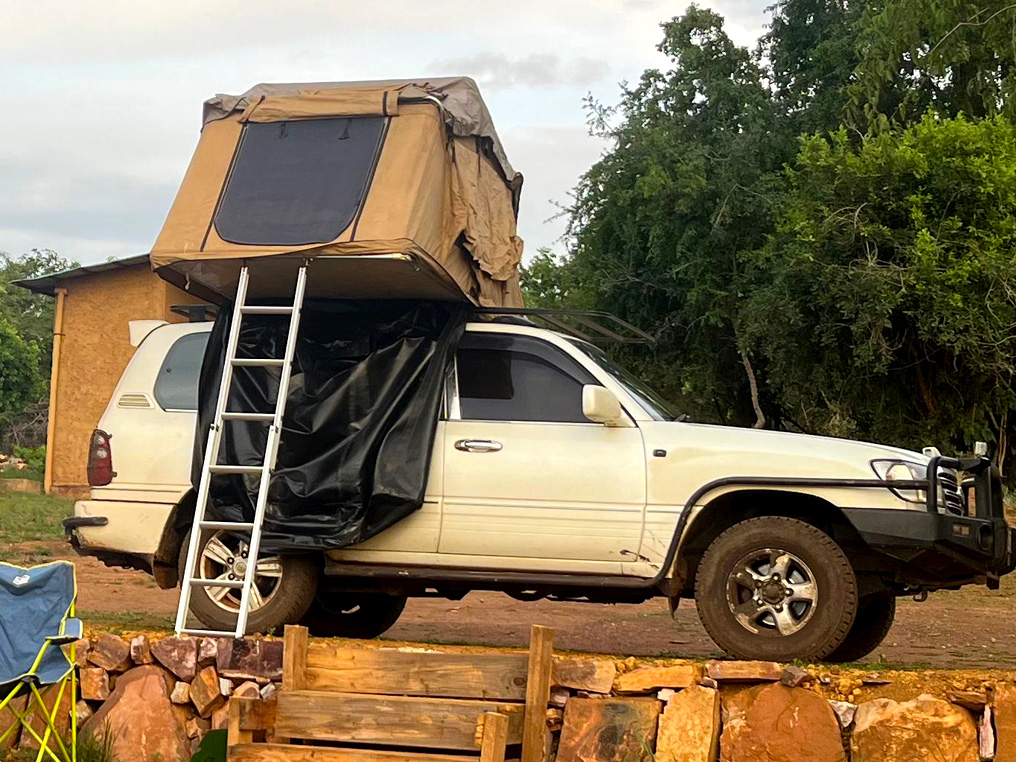
A Uganda 4×4 rooftop tent self-drive safari offers freedoms that no guided tour or lodge safari can match. You leave when you want, stay where the wildlife is, and experience Uganda at the intimate pace of an overlander rather than a tourist. The rooftop tent places you above the bush, away from ground-level moisture and insects, with elevated views that transform the pre-dawn African landscape into something transcendent. Uganda’s national park campsites are some of the finest in East Africa: Mweya’s channel views, Apoka’s Narus Valley panoramas, and Rwonyo’s Lake Mburo waterhole are experiences exclusive to those who sleep under canvas.
A 40-day itinerary gives Uganda the time it deserves – not rushing past parks to tick boxes, but lingering long enough to watch lion cubs learn to stalk, to sit with a mountain gorilla family as afternoon rain patters through the canopy, and to drive empty red roads as the sun rises over an Africa that has barely changed in a thousand years.